Last updated: October 20, 2026
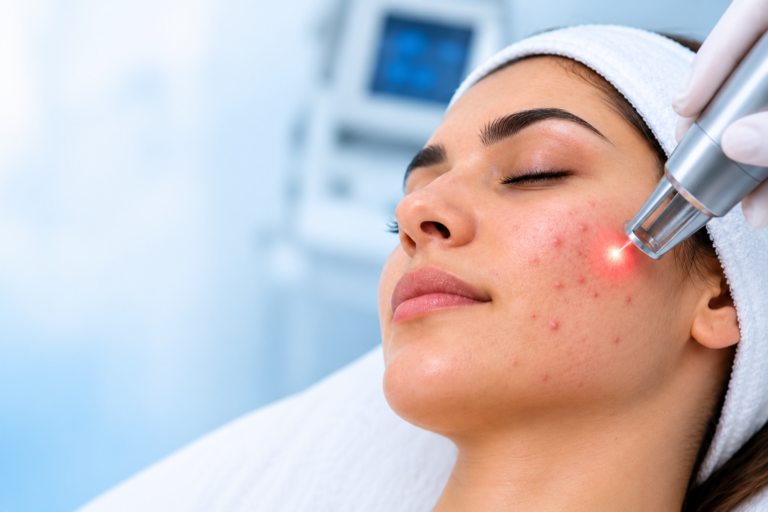
Fractional CO2 laser is one of the most effective non-surgical treatments for fine lines and crepey skin under the eyes. It isn’t the right answer for every under-eye concern, though. It improves the skin itself, but it doesn’t fill hollows or remove puffy fat pads.
This guide explains what CO2 laser under the eyes can and can’t do, what recovery looks like day by day, the risks and what affects the cost. It also covers when fillers or eyelid surgery are a better choice. If you’re considering treatment for your whole face, see our full-face CO2 laser guide.
Quick answers
| Question | Short answer |
|---|---|
| What does it treat best? | Fine lines, crepey skin, sun damage and mild loose skin under the eyes |
| What doesn’t it fix? | Puffy eye bags (fat pads), hollow tear troughs and dark circles caused by blood vessels or shadows |
| How long is the downtime? | About 7–10 days of redness, swelling and peeling; pinkness can last a few more weeks |
| When will I see results? | Skin looks smoother at about 2 weeks; collagen keeps building for 3–6 months |
| How many sessions? | Results are often achieved in one session; a series of 3 is typical for the most significant results, then an annual maintenance treatment |
| How long do results last? | Several years, if you protect your skin from the sun |
What CO2 laser under the eyes can and can’t fix
The skin under the eyes is some of the thinnest on the body, and it shows sun damage and collagen loss early. A fractional CO2 laser makes thousands of tiny columns of controlled injury in the skin, while leaving the skin around each column intact. As the skin heals, it builds new collagen and elastin, so it gradually becomes firmer and smoother.
That makes it very good at improving the quality of the skin. It doesn’t change the shape of the area.
The American Academy of Dermatology describes laser resurfacing as the most effective non-surgical procedure for tightening loose skin.
| Under-eye concern | Does CO2 laser help? | Often a better fit |
|---|---|---|
| Fine lines and crow’s feet | Yes, very well | Add Botox for lines that form when you smile |
| Crepey, thin skin | Yes, very well | — |
| Sun damage and rough texture | Yes, very well | — |
| Mild loose skin | Yes, moderately | — |
| Dark circles from thin skin or sun spots | Sometimes | — |
| Dark circles from visible blood vessels | Rarely | Vascular laser |
| Hollow tear troughs or shadows | No | Dermal fillers |
| Puffy eye bags (fat pads) | No | Lower eyelid surgery (blepharoplasty) |
| A lot of excess eyelid skin | Limited | Eyelid surgery, sometimes combined with laser |
Many people have more than one of these at once. A consultation sorts out which concern bothers you most and which treatment, or combination, fits it.
Are you a good candidate?
Age matters less than the condition of your skin. Most people who choose this treatment are in their late 30s to early 60s.
You may be a good candidate if you have:
- Fine lines, crepey skin or sun damage under the eyes
- Mild to moderate loose skin
- Good general health and realistic expectations
- About a week you can take off from work and social plans
You may need to wait, or choose another treatment, if you:
- Have an active skin infection or cold sore near the area
- Take isotretinoin, or have stopped it recently
- Have a fresh tan or sunburn
- Have a history of keloids or thick scars
- Have conditions that slow healing, such as poorly controlled diabetes
- Are pregnant or breastfeeding
Darker skin tones: CO2 laser can still be an option, but the risk of temporary dark patches (post-inflammatory hyperpigmentation) is higher. Gentler settings, skin preparation beforehand or a different treatment may be safer. The American Academy of Dermatology notes that darker skin is more prone to burns and dark marks after laser treatment, so experience with darker skin matters. Dr. Weiss decides this at the consultation.
What happens on treatment day
Preparation starts weeks before the treatment itself. These steps follow Trillium’s own CO2 laser pre-treatment instructions.
- Consultation. We take before photos, go over the plan and send in your prescriptions: an antibiotic, an antiviral to prevent cold sores, and Valium if you want it. We’ll also go over optional Pronox (nitrous oxide) for extra comfort.
- 4 weeks before. Avoid sun, tanning beds and self-tanner. If you’re tanned, treatment may need to be rescheduled.
- 1 week before. Stop tretinoin (Retin-A), glycolic acid, benzoyl peroxide and other harsh products on the treatment area.
- The day before. Start the antibiotic and antiviral as directed.
- Treatment day. Come with clean skin: no makeup, creams or contact lenses. A numbing cream goes on about an hour beforehand. A small amount of local anesthetic may also be injected under the eyes, which is an extra-sensitive area. You wear protective eye shields throughout. Most people say the laser feels like being snapped with a rubber band. If you take Valium, someone needs to drive you home.
- Right after. Aquaphor is applied, and the skin feels sunburned and tight. A burning sensation can last up to about 5 hours.
Recovery day by day
The skin looks worse before it looks better. That’s normal and expected.
| Time after treatment | What’s normal | What to do |
|---|---|---|
| Day of treatment | Burning, tightness, sunburned look | Apply Aquaphor every 4–6 hours with clean hands; don’t wash your face; sleep with your head raised |
| Days 1–3 | Redness, swelling, a dark tan look; possibly a fine scab | Shower in cool water and let it run over your face; wash gently with the cleanser provided; keep up the Aquaphor; no strenuous exercise for at least 3 days |
| Days 3–7 | The skin darkens around days 3–4, then peels from about day 5 | Don’t pick or peel; switch to the repair cream provided twice a day from day 4 |
| About 1 week | Most peeling is done | Follow-up visit to plan your new skincare routine and when to restart makeup and retinoids. Don’t use old makeup or brushes before day 7 |
| Weeks 2–8 | Pinkness fades; collagen starts rebuilding | Mineral (zinc or titanium) sunscreen every day, plus a hat and sunglasses |
| Months 3–6 | Lines and crepiness keep softening; some brown discoloration can linger for up to 6 months | Avoid direct sun for 6 months, even through a car window |
Aftercare that makes a difference
- Finish the antibiotic and antiviral exactly as prescribed
- Keep the treated skin coated in Aquaphor until peeling starts, then use the repair cream
- Wash only with your hands and the gentle cleanser; no washcloths or scrubbing
- Wait until the 1-week visit before restarting retinoids or acids
- Avoid direct sun for 6 months. Wear a zinc or titanium sunscreen every day (Dr. Weiss’s Defend Facial Sunscreen is provided), plus a hat and sunglasses
- Don’t smoke; it slows healing
The full aftercare sheet is on our Treatment Instructions page.
Call the office straight away if you have pain that’s getting worse instead of better, yellow crusting or pus, fever, new blisters, swelling that keeps increasing after day 3, or any change in your vision.
Results: what to expect and when
Most people notice smoother, brighter skin once the peeling finishes, at about two weeks. The bigger change comes later: new collagen keeps forming for three to six months, so fine lines and crepiness keep softening.
Typical results include:
- Softer fine lines and crow’s feet
- Firmer, smoother lower-eyelid skin
- Less crepey texture
- More even tone where sun damage was the cause
The aim is a natural, rested look, not perfectly smooth skin. Results are frequently achieved in one session, and a series of 3 sessions is typically recommended for the most significant results. Dr. Weiss recommends an annual maintenance treatment after the first series. Results can last for years, but the skin keeps aging, so daily sunscreen protects the result.
In a study published in the Journal of the American Academy of Dermatology, lower-eyelid skin texture, laxity and wrinkles improved by about 62–65% six months after 2 to 3 fractional CO2 sessions.
| Before | 3 months after CO2 laser |
|---|---|
 |  |
See more results in our Before/After Gallery.
Risks and side effects
Serious problems are uncommon when an experienced dermatologist chooses the settings. Know these before you book:
- Expected: redness, swelling and peeling for 7–10 days, then pinkness for a few weeks
- Temporary dark patches: more likely in darker skin or after sun exposure; usually treatable
- Cold sore flare: the reason an antiviral is prescribed beforehand
- Infection: rare; follow the aftercare instructions closely
- Lighter patches or scarring: rare
- Lower eyelid pulling down (ectropion): rare, which is why careful settings on the eyelid matter
How much does CO2 laser under the eyes cost?
Under-eye CO2 laser typically costs $1,000–$2,500 per session in the U.S. Your exact price is confirmed at your consultation and depends on:
- Whether only the under-eye area is treated or the full face
- How deep the treatment is
- How many sessions you need (a series of 3 is typical)
CO2 laser for wrinkles is cosmetic, so insurance doesn’t cover it. Trillium accepts the CareCredit health and beauty credit card:
- Special financing is available on purchases of $200 or more (subject to credit approval)
- You can check whether you prequalify online without affecting your credit score
- You can pay online up to 30 days before your appointment
If you combine laser with Botox or fillers, those injectables can earn points through the manufacturer rewards programs listed on our Cosmetic Rewards page (Allē, ASPIRE and Xperience+).
CO2 laser vs. fillers vs. eyelid surgery
| CO2 laser | Dermal fillers | Lower eyelid surgery | |
|---|---|---|---|
| Best for | Fine lines, crepey skin, sun damage | Hollow tear troughs and shadows | Puffy eye bags and excess skin |
| Downtime | About 7–10 days | 0–2 days (possible bruising) | 1–2 weeks or more |
| How long it lasts | Years | About 9–18 months, depending on the filler | Many years |
| Can they be combined? | Yes, often with fillers or Botox | Yes | Sometimes with laser |
If your main concern is hollows, fillers usually help more. If it’s puffy bags, surgery does. When both the skin quality and the shape have changed, a combination usually gives the most natural result.
Book a consultation
Not sure whether laser, filler or a combination is right for your under-eye area? Dr. Weiss and the team will look at what’s causing your concerns and recommend the option that fits. Schedule a consultation online or call 919-710-8100.
CO2 laser consultations and treatments are available at all three Trillium offices: Chapel Hill, Smithfield and Burlington. See all laser resurfacing options.