Precise Skin Cancer Removal With Same-Day Margin Evaluation
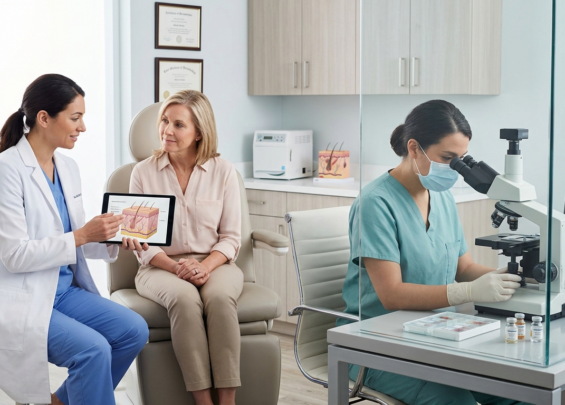
Mohs surgery is a highly precise treatment for certain skin cancers, allowing your surgeon to examine each layer of tissue under a microscope during the procedure and remove additional tissue only when cancer cells remain. This approach helps preserve as much healthy skin as possible while achieving clear margins.
At Trillium Dermatology, Dr. Stefan Weiss, a board-certified dermatologist with Mohs training, performs Mohs surgery with microscopic margin evaluation and personalized wound repair at our Chapel Hill location. Mohs surgery is part of our broader surgical dermatology services for diagnosing and treating conditions that may require surgical care.
Need Mohs After a Biopsy?
If you’ve already had a skin biopsy and were told you need Mohs surgery, you can bring your pathology report to your consultation so Dr. Weiss can review the diagnosis with you.
What Is Mohs Surgery?
Mohs micrographic surgery is a highly specialized technique for removing skin cancer while preserving as much healthy tissue as possible. Unlike traditional excision, where the surgeon removes the tumor with a predetermined margin and the tissue is examined after the procedure, Mohs allows the surgeon to examine the tissue during the surgery.
Here’s how it works:
1. The visible cancer is removed
After the area is numbed with local anesthesia, Dr. Weiss removes the visible portion of the skin cancer along with a thin layer of surrounding tissue.
2. The tissue is examined under a microscope
The tissue is carefully mapped, processed, and examined in the laboratory at Trillium. The edges, or margins, are checked for remaining cancer cells.
3. Additional tissue is removed only where cancer remains
If cancer cells are found at a margin, another thin layer is removed from that specific area and examined again.
4. The process continues until the margins are clear
Once microscopic examination confirms that no cancer cells remain at the margins, the cancer has been completely removed.
5. The wound is repaired
After the cancer is cleared, Dr. Weiss determines the most appropriate way to repair the wound based on its size, depth, and location.
Why this matters
The defining advantage of Mohs is precision. Rather than removing a predetermined amount of surrounding skin, the surgeon removes tissue layer by layer and uses microscopic examination to determine exactly where the cancer ends.
That means less unnecessary removal of healthy tissue, which can be particularly important when treating skin cancers on areas such as the face, nose, ears, eyelids, lips, hands, and other areas where preserving tissue and function matters.
Why Choose Trillium for Mohs Surgery?
Choosing a Mohs surgeon is about more than finding someone who can remove a skin cancer. You also want to know who will perform the procedure, how the cancer margins will be evaluated, and how the wound will be repaired once the cancer is completely removed.
At Trillium Dermatology, Dr. Stefan Weiss, a board-certified dermatologist with training in Mohs micrographic surgery, performs Mohs surgery at our Chapel Hill location. The procedure, microscopic margin evaluation, and wound repair are coordinated as part of your care at Trillium.
Same-Visit Microscopic Margin Evaluation
One of the defining features of Mohs surgery at Trillium is the in-house laboratory. Tissue removed during the procedure is processed and examined microscopically during your visit. If cancer cells remain at a margin, another layer can be removed and evaluated rather than waiting for a separate pathology appointment.
A Tissue-Sparing Approach
Mohs is designed to remove cancer while preserving as much healthy tissue as possible. Because each layer is examined before another is removed, the surgeon can focus additional removal only on areas where cancer remains. This can be particularly valuable when treating skin cancers in cosmetically or functionally important areas.
Personalized Wound Repair
Once clear margins are confirmed, the remaining wound is evaluated and repaired according to its size, depth, and location. Depending on the defect, repair may involve stitches, a skin flap, a skin graft, or allowing the wound to heal naturally. The goal is to achieve reliable healing while considering the function and appearance of the treated area.
Convenient Access to Mohs Care
Trillium Dermatology provides Mohs surgery in Chapel Hill for patients from Chapel Hill and surrounding communities, including Carrboro, Durham, Hillsborough, Pittsboro, Mebane, Burlington, Smithfield, Cary, Apex, Raleigh, Clayton, and Garner.
Who Is Mohs Surgery Recommended For?
Mohs surgery is not necessary for every skin cancer. It is most valuable when complete cancer removal needs to be balanced with preserving as much healthy tissue as possible.
Mohs may be recommended when a skin cancer:
- Is located in an area where preserving healthy tissue matters, such as the face, nose, eyelids, ears, lips, hands, or other functionally or cosmetically sensitive areas.
- Has an unclear or poorly defined border, making it difficult to determine how much tissue needs to be removed with a standard excision.
- Has returned after previous treatment, since recurrent skin cancers can be more difficult to remove completely.
- Is considered higher risk based on its type, size, location, or other characteristics.
- Extends into areas where tissue preservation is particularly important, making the precise, layer-by-layer approach of Mohs especially useful.
Mohs Is Not Always the Right Choice
Mohs is a specialized procedure, not a default treatment for every skin cancer. For some low-risk cancers in areas where tissue preservation is less critical, standard surgical excision may provide an appropriate alternative. Other treatments may also be considered depending on the type and characteristics of the cancer.
The decision is based on factors such as the type of skin cancer, its location, size, borders, whether it has returned, and the patient’s individual circumstances. Your dermatologist can explain why Mohs, or another treatment, is recommended for your specific diagnosis.
Which Skin Cancers Can Mohs Treat?
Mohs surgery is most commonly used to treat basal cell carcinoma (BCC) and squamous cell carcinoma (SCC), particularly when the cancer is in a high-risk location, has an indistinct border, has returned after previous treatment, or requires careful preservation of surrounding healthy tissue.
Basal Cell Carcinoma (BCC)
Basal cell carcinoma is the most common type of skin cancer and is often highly treatable when diagnosed and treated early. Mohs may be recommended for BCCs that are aggressive, recurrent, large, located in areas where tissue preservation is especially important, or difficult to define clinically.
Squamous Cell Carcinoma (SCC)
Squamous cell carcinoma can sometimes behave more aggressively than BCC, making appropriate treatment particularly important. Mohs may be recommended when an SCC is located in a high-risk area, has an unclear border, has returned after treatment, shows other high-risk characteristics, or is growing along a nerve or blood vessel.
What About Melanoma?
Mohs is not the standard approach for every melanoma. However, specialized forms of Mohs, including staged techniques sometimes called slow Mohs, may be considered for selected early melanomas such as lentigo maligna, particularly in anatomically sensitive areas where tissue preservation is important. The appropriate treatment depends on the melanoma’s type, depth, location, and other clinical factors.
Other Rare Skin Cancers
Mohs may also be used selectively for certain rare skin cancers. The decision depends on the specific tumor and its clinical characteristics, so a specialist evaluation is important before determining whether Mohs is appropriate.
Is Mohs Always the Right Choice?
No. Mohs surgery is highly specialized, but it isn’t the right treatment for every skin cancer. The best approach depends on the type of cancer, its location, size, borders, whether it has returned after previous treatment, and other patient-specific factors. The American Academy of Dermatology’s Mohs Appropriate Use Criteria likewise considers tumor type, location, recurrence status, and the patient’s health profile when determining whether Mohs is appropriate.
When Mohs May Be Preferred
Mohs is particularly valuable when:
- The cancer is located where preserving healthy tissue is important, such as the nose, eyelids, ears, lips, hands, or other functionally or cosmetically sensitive areas.
- The tumor has poorly defined borders, making it difficult to determine its full extent.
- The cancer is large, aggressive, or fast-growing.
- The cancer has returned after previous treatment.
- The tumor is located in or near scar tissue.
- The cancer’s characteristics make precise margin control especially important.
When Another Treatment May Be Appropriate
For some lower-risk skin cancers, standard surgical excision may be an appropriate treatment. Other options can include curettage and electrodesiccation, cryosurgery, topical medications, radiation therapy, or other approaches depending on the diagnosis and individual circumstances.
The goal isn’t to choose the most advanced-sounding procedure. It’s to choose the treatment that offers the best balance of cancer control, tissue preservation, function, appearance, and the patient’s individual needs.
Why This Matters
If your dermatologist has recommended Mohs, it’s reasonable to ask why Mohs is being recommended for your particular cancer and what alternatives may be available. Your surgeon should be able to explain the reasoning and what the procedure is intended to accomplish.
What Are the Benefits of Mohs Surgery?
Mohs surgery offers an important combination of precise cancer removal and healthy-tissue preservation. Because the surgeon examines the margins during the procedure, treatment can continue only where cancer cells remain rather than removing a predetermined amount of surrounding skin.
Precise Margin Control
With Mohs, the tissue removed during surgery is examined under a microscope before the procedure is considered complete. If cancer cells remain at the edge of the tissue, another thin layer can be removed from that specific area and examined again. This continues until the margins are clear.
Preservation of Healthy Skin
Because additional tissue is removed only when cancer cells are identified, Mohs can preserve more healthy skin than a procedure based on a predetermined surgical margin. This is especially valuable on areas where even a small amount of unnecessary tissue removal can affect appearance or function, such as the nose, eyelids, ears, lips, and hands.
High Cure Rates
Mohs offers among the highest cure rates for appropriately selected skin cancers because the surgeon examines the surgical margins during treatment. The exact likelihood of cure depends on the type and characteristics of the cancer, so your surgeon can discuss what the expected outcome is for your particular diagnosis.
Treatment and Margin Evaluation During the Same Visit
Rather than removing the tumor and waiting for a separate pathology result to determine whether additional surgery is needed, Mohs incorporates microscopic margin evaluation into the procedure itself. At Trillium, tissue is processed and examined in the in-house laboratory during your visit.
Personalized Wound Repair
Once the cancer has been completely removed, the final wound is evaluated and repaired based on its size, depth, and location. Depending on the defect, options may include stitches, a skin flap, a skin graft, or allowing the wound to heal naturally.
What These Benefits Mean for You
The goal of Mohs isn’t simply to remove a skin cancer. It is to achieve complete cancer removal while preserving as much healthy tissue as reasonably possible, particularly when the cancer affects an area where appearance or function matters.
What Happens During Mohs Surgery?
Knowing what will happen on the day of surgery can make the experience feel much less intimidating. Mohs surgery is usually performed as an outpatient procedure under local anesthesia, so you remain awake while the surgical area is completely numbed. For a more detailed overview of what to expect before, during, and after Mohs surgery, read our patient guide.
Step 1: The Area Is Examined and Numbed
Dr. Weiss examines the area to be treated and marks the surgical site. Local anesthetic is then injected to numb the area. You may feel the injection and some pressure during the procedure, but you should not feel the surgical removal itself.
Step 2: The Visible Cancer Is Removed
The visible portion of the skin cancer is removed along with a thin layer of surrounding tissue. This first layer is carefully prepared for microscopic examination.
Step 3: The Tissue Is Processed and Examined
The removed tissue is mapped and processed in the Mohs laboratory. The undersurface and edges of the tissue are examined under a microscope to determine whether cancer cells remain.
Step 4: Additional Layers Are Removed Only Where Needed
If cancer cells are found at the margins, Dr. Weiss returns to the surgical site and removes another thin layer only from the area where cancer remains. That layer is then processed and examined again.
Step 5: The Process Continues Until the Margins Are Clear
The process of removing and examining tissue continues until microscopic examination shows no remaining cancer cells at the margins. This layer-by-layer approach is what allows Mohs to combine precise cancer removal with preservation of as much healthy tissue as possible.
Step 6: The Wound Is Repaired
Once the cancer has been completely removed, Dr. Weiss evaluates the resulting wound and discusses the most appropriate repair. Depending on its size, depth, and location, the wound may be closed with stitches, repaired with a flap or graft, or allowed to heal naturally.
How Long Does Mohs Surgery Take?
The actual removal of the cancer may be relatively quick, but the overall appointment can take several hours because each tissue layer must be processed and examined before the next decision can be made.
The number of stages varies from patient to patient. You should plan to spend most of the day at the clinic rather than scheduling other important commitments immediately afterward. The exact duration depends on how many stages are needed and how complex the final wound repair is.
What You Can Do While You Wait
Bring something comfortable to read or listen to while the laboratory work is being completed. You may be able to eat and drink during the waiting periods, depending on your surgical team’s instructions.
How to Prepare for Mohs Surgery
Once your Mohs surgery is scheduled, a little preparation can make the day much easier. Follow the specific instructions provided by your Trillium surgical team, particularly regarding medications and any medical conditions.
Before Your Appointment
Bring your medication list.
Tell your surgical team about all prescription medications, over-the-counter medicines, vitamins, and supplements you take. In particular, let them know if you take blood thinners or medications that may affect bleeding. Do not stop any prescribed medication unless your physician or surgical team specifically tells you to.
Tell us about your medical history.
Make sure your team knows about conditions that may affect surgery or healing, including bleeding disorders, immune-system conditions, implanted medical devices, or medication allergies.
Eat and drink as instructed.
Mohs surgery is generally performed using local anesthesia, but your team will tell you whether you should eat and drink normally before your appointment. Follow their instructions rather than relying on general surgical guidelines.
Plan for a few hours at the clinic.
Mohs surgery is performed in stages, and each tissue layer must be processed and examined before the next step can be determined. The total appointment can therefore take several hours, even when the actual surgical removal is relatively brief.
Wear comfortable clothing.
Choose clothing that is easy to put on and remove and won’t put unnecessary pressure on the surgical area.
Plan your transportation according to your team’s instructions.
Because Mohs is generally performed under local anesthesia, a driver is not automatically required for every patient. If sedation, additional medication, or the location/extent of your procedure changes that recommendation, your Trillium team will let you know.
What to Bring
- A current list of your medications and supplements
- Your insurance information and identification
- Any relevant pathology reports or medical records not already provided
- Something to read, listen to, or work on during laboratory processing
- A list of questions or concerns you’d like to discuss with your surgical team
If Your Biopsy Was Performed Somewhere Else
You don’t need to repeat a biopsy simply because you are having Mohs at Trillium. If another dermatologist or physician diagnosed your skin cancer, ask their office to send your pathology report to Trillium before your appointment. Our team can review the available information and determine the appropriate next step.
What Is Mohs Surgery Recovery Like?
Most patients find that Mohs surgery recovery is manageable, particularly because the procedure is generally performed under local anesthesia. However, your recovery will depend on the size and location of the wound, how it was repaired, and the specific instructions provided by your surgical team.
The First 24–48 Hours
Some swelling, bruising, mild discomfort, redness, or a small amount of bleeding can occur after surgery. These effects are often temporary.
Keep the surgical site protected and follow your wound-care instructions carefully. Depending on the repair, your instructions may include when to change the dressing, how to clean the area, and whether to apply petroleum jelly or another prescribed ointment.
If your surgical site is on the face, keeping your head elevated while resting or sleeping may help reduce swelling. Avoid activities that your surgical team has specifically restricted, particularly strenuous exercise or anything that could put pressure on or injure the wound.
The First Week
Continue your prescribed wound care and keep all scheduled follow-up appointments. If you have stitches, your surgical team will tell you when they should be removed; the timing varies depending on the location and type of repair.
You may be able to return to many normal activities relatively quickly, but do not assume that a generic recovery timeline applies to your wound. Your activity restrictions should be based on the location and complexity of your repair and the instructions provided by Trillium.
The Following Weeks and Months
Once the wound has closed, the area will continue to change as the scar matures. It may initially appear red, raised, firm, or uneven. These changes can improve substantially with time.
Scar maturation can take a year or longer, so don’t judge the final appearance of your scar during the first few weeks or months.
If you’re concerned about the appearance or feel of your scar as it heals, bring it up at a follow-up appointment. Additional treatments may sometimes be considered to optimize the final result.
When Should I Call Trillium?
Contact your surgical team if you experience symptoms that concern you or appear to be worsening rather than improving. These may include:
- Bleeding that does not stop with the pressure instructions provided by your surgical team
- Increasing pain rather than gradual improvement
- Increasing redness, warmth, swelling, or drainage around the wound
- Fever or other signs of infection
- Separation of the wound or problems with the repair
- Any other unexpected change that concerns you
When in doubt, contact your Trillium surgical team rather than trying to diagnose a complication yourself.
Protecting Your Skin After Mohs
Having one skin cancer increases your risk of developing additional skin cancers, so Mohs surgery should be viewed as part of your long-term skin-health plan rather than the end of it. Regular skin examinations and awareness of new or changing lesions remain important after treatment.
Protect your skin from ultraviolet exposure by using broad-spectrum sunscreen, wearing protective clothing, seeking shade, and avoiding intentional tanning. Continue the skin-check schedule recommended by your dermatologist.
Will Mohs Surgery Leave a Scar?
Any surgery that cuts the skin will leave some degree of scarring. The goal of Mohs surgery is not to make a scar impossible, but to remove the cancer completely while preserving healthy tissue and creating the best possible conditions for the wound to heal well.
The final appearance of your scar depends on several factors, including the size and depth of the cancer, where it is located, how the wound is repaired, your skin type, and how your body heals.
How Mohs Can Help Minimize the Impact of a Scar
Because Mohs removes cancer layer by layer and additional tissue is taken only where cancer remains, the procedure can help preserve healthy skin around the tumor. This can be particularly important when treating areas such as the nose, eyelids, ears, lips, and other visible or functionally important locations.
Once the cancer has been completely removed, the resulting wound may be repaired in several ways:
- Primary closure: The edges of the wound are brought together with stitches.
- Local flap: Nearby skin is moved into the area to repair the defect while maintaining the area’s natural contours.
- Skin graft: Skin from another location is used to cover the wound.
- Secondary intention: In selected cases, the wound is allowed to heal naturally without being closed with stitches.
The appropriate repair depends on the wound’s size, depth, location, and other individual factors. Your surgeon will discuss the available options with you.
What Does a Mohs Scar Look Like as It Heals?
Scars rarely look their best immediately after surgery. During the early stages of healing, a scar may appear red, raised, firm, or more noticeable than you expected.
Over time, scar tissue gradually remodels. It can take 12 to 18 months or longer for a scar to mature, and its appearance may continue to improve throughout that period.
If a scar remains raised, discolored, uncomfortable, or otherwise bothersome after healing, additional scar-management treatments may sometimes be considered.
The Goal: Cancer Control and the Best Possible Repair
For Mohs surgery, the priority is always complete removal of the skin cancer. Once clear margins have been confirmed, the focus shifts to repairing the wound in a way that supports healing while considering both function and appearance.
Your surgeon can discuss what to expect based on the specific location and size of your skin cancer before the procedure.
Insurance and Referrals
Being told you need Mohs surgery can leave you with practical questions beyond the procedure itself. Do I need a referral? What if my biopsy was done somewhere else? Will my insurance cover the surgery?
Here’s what you need to know.
Do I Need a Biopsy Before Mohs Surgery?
Yes. Mohs surgery is performed after a skin cancer diagnosis has been established through a biopsy and pathology evaluation.
If you have a suspicious spot but haven’t had a biopsy, you can schedule a dermatology evaluation first. If appropriate, Trillium can perform a biopsy during that visit and determine the next step based on the pathology results.
Can I Have Mohs Surgery at Trillium If My Biopsy Was Done Elsewhere?
Yes. You don’t need to have your biopsy performed at Trillium to have Mohs surgery here.
If another dermatologist or physician diagnosed your skin cancer, ask their office to send the pathology report to Trillium before your appointment. You can also bring a copy with you. Reviewing the report ahead of time allows our team to understand your diagnosis and prepare for your consultation.
Does Insurance Cover Mohs Surgery?
Mohs surgery for a diagnosed skin cancer is generally considered a medically necessary procedure and is covered by most insurance plans, including Medicare. However, coverage, deductibles, copays, referrals, and prior-authorization requirements vary by plan.
Check your specific benefits with your insurance carrier, and our team can help you understand what information or authorization your plan requires.
How Soon Can I Be Seen?
Our goal is to evaluate patients requesting Mohs surgery within 10 days of contacting Trillium.
If you’ve already had a biopsy, sending your pathology report before your appointment can help our team prepare in advance.
Mohs Surgery in Chapel Hill and Nearby Communities
If you’re looking for Mohs surgery in Chapel Hill, Trillium Clinic provides specialized skin cancer treatment from our Chapel Hill office at 100 Timberhill Place, Suite 110.
Patients come to Trillium for Mohs surgery and skin cancer treatment from communities throughout the Triangle and central North Carolina, including:
- Chapel Hill
- Carrboro
- Durham
- Hillsborough
- Pittsboro
- Mebane
- Burlington
- Smithfield
- Cary
- Apex
- Raleigh
- Clayton
- Garner
If you live outside Chapel Hill, you don’t necessarily need to travel far from home for specialized skin cancer care. Our locations make it possible for patients throughout the surrounding communities to access Trillium’s dermatology and Mohs services.
Schedule Your Mohs Consultation
Ready to Take the Next Step?
If you’ve been diagnosed with skin cancer and your dermatologist has recommended Mohs surgery, the next step is a consultation. Dr. Weiss will review your diagnosis, examine the treatment site, and explain whether Mohs is appropriate for your skin cancer and what your treatment may involve.
Already Had a Biopsy?
You don’t need to start over if your biopsy was performed by another dermatologist or physician. Ask your referring provider to send your pathology report to Trillium before your appointment whenever possible. Reviewing it in advance helps our team prepare for your visit.
Haven't Had a Biopsy Yet?
If you have a suspicious skin lesion but don’t have a confirmed diagnosis, schedule a dermatology evaluation first. A biopsy may be performed during that visit if appropriate. Mohs surgery can then be considered once the pathology confirms the diagnosis.
Need to Be Seen Soon?
Our goal is to evaluate patients requesting Mohs surgery within 10 days. Sending your pathology report before your visit can help our team prepare and may shorten the path to treatment.
Start Your Mohs Consultation
Or call our Chapel Hill office at 919-710-8100 with questions or to get started.
Mohs Surgery FAQ
What is Mohs surgery?
Mohs micrographic surgery removes skin cancer in thin layers, examining each layer under a microscope during the procedure until no cancer cells remain at the margins. This allows the surgeon to treat the cancer while preserving as much healthy skin as possible.
When is Mohs surgery recommended?
Mohs is most often used for basal cell carcinoma and squamous cell carcinoma, particularly when the cancer is in an area where tissue preservation matters or when the tumor is large, recurrent, aggressive, or has poorly defined borders. Your dermatologist will consider your specific diagnosis and pathology before recommending Mohs.
Do I need a biopsy before Mohs surgery?
Yes. Mohs surgery treats a confirmed skin cancer, so a biopsy establishing the diagnosis is required before Mohs can be scheduled. If you have a suspicious spot but haven’t had a biopsy, Trillium can evaluate it and perform a biopsy when appropriate.
Can I have Mohs surgery at Trillium if my biopsy was done elsewhere?
Yes. Trillium treats patients referred from other practices. Ask your referring provider to send your pathology report to the office, or bring a copy with you, so the team can review the diagnosis during your consultation.
How soon can I be seen for Mohs surgery?
Trillium’s goal is to evaluate patients requesting Mohs surgery within 10 days of requesting an appointment. If you’ve already had a biopsy, sending your pathology report before the visit can help the team prepare in advance.
What types of skin cancer can be treated with Mohs surgery?
Mohs is used most often for basal cell carcinoma and squamous cell carcinoma. Melanoma and rarer skin tumors may require a different surgical approach or coordination with another specialist, depending on the diagnosis and pathology.
How long does Mohs surgery take?
Plan to spend several hours at the clinic and keep the rest of your day open. The surgical removal itself may be brief, but each tissue layer must be processed and examined before the next step can be determined. Many skin cancers clear in one to three stages, although the number of stages varies.
Is Mohs surgery painful?
The treatment area is numbed with local anesthesia, so you should not feel pain during the procedure, although pressure or tugging can be normal. Afterward, some soreness is expected and is often manageable with acetaminophen. Follow the pain-management instructions provided by your surgical team.
Will Mohs surgery leave a scar?
Yes. Any surgery that cuts the skin leaves a scar. Mohs is designed to remove only the tissue necessary to clear the cancer, and the wound is then repaired based on its size, depth, and location. Scars can continue to fade and mature over 12 to 18 months or longer.
Can I drive myself home after Mohs surgery?
Many patients can drive themselves because Mohs is generally performed using local anesthesia. However, you may need or prefer a driver depending on the location of the surgery, the size of the repair, or other circumstances. Ask your Trillium surgical team what is appropriate for your procedure.
Does insurance cover Mohs surgery?
Mohs surgery for a diagnosed skin cancer is generally considered medically necessary and is covered by most insurance plans, including Medicare. Coverage and requirements vary, however, and some plans may require a referral or prior authorization. Check your specific benefits, and Trillium’s team can help with questions about what your plan requires.
What should I do after Mohs surgery?
Your surgical team will provide specific wound-care and activity instructions based on the location and type of repair. Follow those instructions carefully, attend your scheduled follow-up, and contact the office if you experience concerning symptoms such as persistent bleeding, increasing redness or swelling, worsening pain, drainage, fever, or problems with the wound.