Mohs Surgery: What to Know About Precise Skin Cancer Removal
Mohs surgery is designed to provide the certainty that comes from knowing a skin cancer has been completely removed. A skin cancer diagnosis changes the way a person experiences their own body. Even when the cancer is caught early, as it very often is with the most common types, there’s an urgency that sets in, a need to have it removed completely and to know with certainty that it’s gone.
At Trillium Dermatology, Mohs micrographic surgery is among the most important procedures performed. It is the most precise method available for removing the two most common forms of skin cancer: basal cell carcinoma and squamous cell carcinoma, and it achieves cure rates that no other single-stage technique can match, over 99%. For patients navigating a skin cancer diagnosis, understanding what Mohs surgery is, how it works, and what the experience involves makes the process far less intimidating.
What Is Mohs Surgery?
Mohs micrographic surgery is a specialized surgical technique developed in the 1930s by Dr. Frederic Mohs, a general surgeon at the University of Wisconsin. Over the following decades, it was refined by dermatologic surgeons into the outpatient procedure used today.
The defining feature of Mohs surgery is real-time, complete margin evaluation: rather than sending tissue to an outside pathology lab and waiting days for results, the Mohs surgeon serves as both surgeon and pathologist, examining 100 percent of the surgical margins immediately in an on-site laboratory.
This matters enormously. Standard excision: the approach used for many surgical removals, examines only a small sampling of the wound margins, a process called “bread-loaf” sectioning that evaluates perhaps one to two percent of the true margin. If cancer cells extend to an edge that wasn’t sampled, the result is a false-negative: the pathology report says clear margins, but cancer remains.
Mohs surgery eliminates this gap by mapping the entire undersurface and edges of each tissue layer before proceeding. Nothing is assumed. Nothing is left to chance.
How Mohs Surgery Works: A Step-by-Step Overview
Mohs surgery is performed as an outpatient procedure under local anesthesia. Patients remain awake and comfortable throughout; there is no general anesthesia, no hospital stay, and no overnight recovery required. Most procedures are completed in a single day.
For a more detailed, patient-focused explanation of what to expect before, during, and after the procedure, read our patient guide to Mohs surgery.
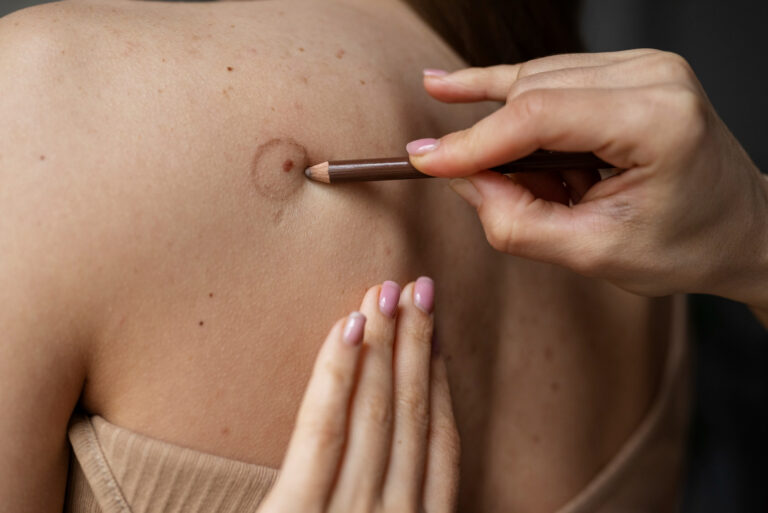
The process begins with the visible tumor being debulked: the clinically apparent cancer is removed along with a very thin margin of surrounding tissue. This first layer of tissue is then carefully mapped, divided, and color-coded so that every millimeter of margin can be precisely located if cancer is found. The tissue is processed in the on-site lab, cut into frozen sections, stained, and examined under the microscope by the Mohs surgeon.
If cancer cells are present at any margin, the map tells the surgeon exactly where. Only that specific area, not the entire wound, is re-excised, preserving as much healthy surrounding tissue as possible. This targeted approach is what makes Mohs surgery uniquely tissue-sparing, particularly important on the face, ears, nose, eyelids, lips, hands, and feet, where unnecessary removal of healthy tissue can have significant cosmetic and functional consequences.
The cycle repeats: remove, map, examine, until all margins are confirmed clear. For many tumors, one or two layers are sufficient. More complex cases may require three or more. Once clear margins are confirmed, the wound is closed. Depending on its size and location, closure may be achieved through primary repair (simple suturing), a flap (using adjacent tissue to fill the defect), a skin graft, or in some cases, allowing the wound to heal naturally on its own.
Why Mohs Surgery Achieves the Highest Cure Rates
The cure rates associated with Mohs surgery are, by the standards of oncologic surgery, exceptional. For primary (previously untreated) basal cell carcinomas, Mohs surgery achieves a five-year cure rate of approximately 99 percent. For primary squamous cell carcinomas, the five-year cure rate is approximately 97 percent. For recurrent tumors, those that have returned after a prior treatment, cure rates remain significantly higher with Mohs than with other treatment approaches, roughly 94 percent for recurrent basal cell carcinoma compared to approximately 80 percent for standard excision.
These numbers reflect the core logic of the technique. When 100 percent of margins are examined in real time and re-excision targets only areas of residual disease, the probability of leaving cancer behind is minimized to a degree that no sampling-based approach can achieve. The surgeon does not leave the operating room uncertain. By the time the wound is closed, complete tumor clearance has been confirmed microscopically.
Who Is a Candidate for Mohs Surgery?
Mohs surgery is not automatically indicated for every skin cancer, and part of the role of the Mohs surgeon is helping patients understand when it is the right choice and when a simpler approach is equally appropriate. The procedure is best suited to specific clinical scenarios where its precision offers a clear advantage.
Tumors on the face, scalp, neck, hands, feet, genitalia, and shins: areas where tissue conservation is critical, or reconstruction is complex, are strong candidates. Cancers at anatomically sensitive sites such as the eyelids, nose, ears, and lips, where even a few millimeters of unnecessary tissue loss can affect function or appearance, are among the most common indications I see.
Tumor characteristics also guide the decision. Large tumors, tumors with poorly defined borders that are difficult to assess clinically, tumors with aggressive histologic subtypes (such as morpheaform or infiltrative basal cell carcinoma, or poorly differentiated squamous cell carcinoma), and tumors arising in scar tissue or chronically sun-damaged skin are all situations where standard excision carries a higher risk of incomplete removal. Mohs surgery removes that uncertainty.
Recurrent tumors, skin cancers that have come back after a prior treatment, are perhaps the most compelling indication of all. When cancer recurs, it often does so along scar tissue planes that mask the true tumor extent, making it nearly impossible to assess clinically. The recurrence rates after re-treating these tumors with standard excision are high. Mohs surgery, with its complete margin mapping, is specifically designed to navigate this complexity.
Immunocompromised patients – those on chronic immunosuppression after organ transplantation, or with certain hematologic conditions – face a substantially elevated risk of aggressive skin cancer behavior and are strong candidates for Mohs surgery even for tumors that might be managed more simply in otherwise healthy individuals.
What to Expect on the Day of Surgery
Patients often arrive nervous, not knowing quite what to expect. By the end of the day, most state that the experience was far more manageable than they had anticipated.
The Procedure Begins With Local Anesthesia
The day begins with local anesthesia injected into the treatment area: the most uncomfortable part of the procedure, and typically over in under a minute. Once numb, the initial debulking takes only a few minutes.
Tissue Processing and Margin Evaluation
The waiting period while the laboratory processes the tissue is where most of the day is spent. Depending on the complexity of the case, each processing cycle takes roughly forty-five minutes to an hour. Patients wait comfortably during this time, and most read, answer email, or simply rest.
I communicate with patients between stages, explaining what was found, where the residual tumor was identified if applicable, and what the next step will be. Informed patients are calmer patients, and I take that conversation seriously.
Wound Closure and Going Home
Once clear margins are confirmed, wound closure is performed. Simple repairs take fifteen to thirty minutes. Flap or graft repairs may take longer. Patients leave the same day with written wound care instructions, a follow-up appointment scheduled, and most importantly, the knowledge that their cancer has been removed completely.
Life After Mohs Surgery
Recovery from Mohs surgery is generally well-tolerated. The wound site will be tender for several days, and patients should expect some swelling, bruising, and mild discomfort managed with over-the-counter analgesics. Vigorous physical activity is typically restricted for one to two weeks to protect the repair and minimize bleeding risk.
What Happens to the Scar?
The scar that forms after Mohs surgery heals progressively over twelve to eighteen months. In many cases, particularly on the face, the repair is designed with cosmetic outcome as a priority; flap closures, for example, are planned to place incision lines within natural skin creases where scars become least visible. For patients with residual scarring concerns after healing is complete, laser scar revision is an option I frequently discuss at follow-up appointments. Although laser scar revision is not covered by Medicare or other health insurance, some patients elect to undergo the procedure for an improved cosmetic outcome. At Trillium Dermatology in Chapel Hill, we use both a CO2 laser as well as the Excel V vascular laser for the improvement of scars.
Ongoing Skin Cancer Surveillance
Skin cancer surveillance is a lifelong commitment after any skin cancer diagnosis. Patients who have had one basal cell or squamous cell carcinoma stand at a meaningfully elevated risk of developing additional primary tumors. Regular full-body skin exams are the foundation of ongoing monitoring, with more frequent visits in higher-risk patients. Sun protection: broad-spectrum SPF 30 or higher, mineral-based, worn daily, is the single most modifiable risk factor, and I discuss it with every patient regardless of medical history.
A Word on Why This Procedure Matters
Skin cancer is extraordinarily common; more Americans are diagnosed with it each year than all other cancers combined, and it is extraordinarily curable when caught and treated appropriately. Mohs surgery is the sharpest tool available for that treatment. When it’s the right procedure for the right patient, it delivers a cure rate that very few oncologic surgeries can claim, while preserving the maximum amount of healthy tissue possible.
The goal at Trillium Dermatology is to ensure that all patients facing a skin cancer diagnosis understand their options clearly, receive the most appropriate treatment for the specific tumor and circumstance, and leave with both the cancer removed and confidence intact.
If you or someone you care about has been diagnosed with basal cell carcinoma or squamous cell carcinoma, or if you have a concerning lesion that hasn’t been evaluated, I encourage you to contact us or your local dermatologist.
Schedule Your Mohs Surgery Consultation in Chapel Hill, NC
A diagnosis of skin cancer can be scary. It is worse when you are referred to a Mohs surgeon and the office tells you that you cannot be seen by the surgeon until several months out.
At Trillium Dermatology, we are committed to scheduling patients for Mohs surgery, when appropriate, within 14 days of receiving a diagnosis.
For patients coming from a dermatology practice other than Trillium Dermatology, we require an in-person consultation, which can be scheduled online prior to scheduling a Mohs surgery treatment. At the visit, you will need to bring a paper copy of your pathology report.
A thorough evaluation is always the first step. And when the answer is Mohs surgery, you can trust that the standard of care at Trillium Dermatology reflects both the science and the seriousness with which we approach your skin health.
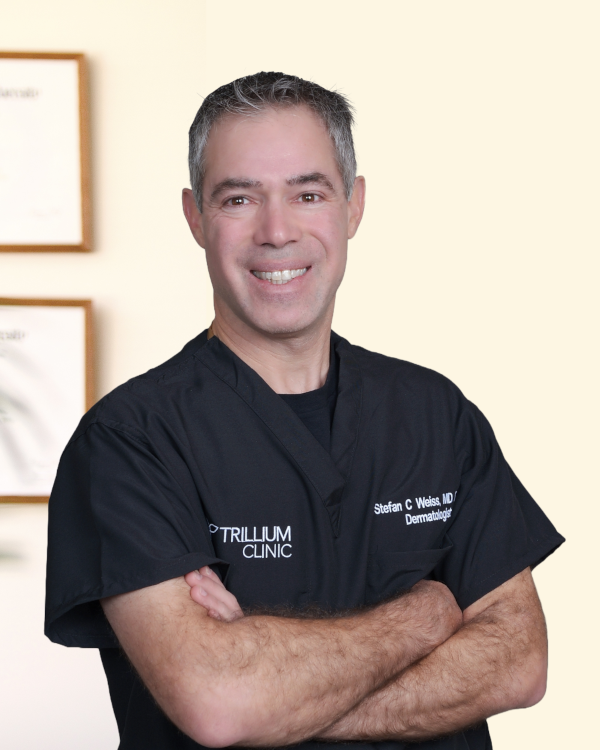
Dr. Stefan Weiss is a board-certified dermatologist and medical director at Trillium Dermatology.
To schedule a consultation for skin cancer or Mohs surgery evaluation, contact our office at 919-710-8100 or visit trilliumclinic.com.