Skin Cyst Treatment: Diagnosis, Removal & What to Expect
Skin cyst removal may be appropriate when a cyst becomes painful, inflamed, infected, or cosmetically bothersome. Few things create more patient anxiety than discovering an unexpected lump beneath the skin. Most of the time, that lump turns out to be something entirely benign: an epidermoid cyst, a pilar cyst, or a lipoma, but knowing that for certain requires an evaluation by a board-certified dermatologist.
At Trillium Clinic, Dr. Stefan Weiss sees patients with skin cysts and subcutaneous lumps regularly, and the message is almost always reassuring: the vast majority are harmless, manageable, and, when needed, straightforwardly removable. If you’re looking for a skin cyst doctor near Chapel Hill, an in-person evaluation is the best way to determine what the lump is and whether skin cyst treatment or removal is appropriate.
Here’s what you need to know about skin cysts: what they are, how they differ from one another, when to seek care, and what treatment looks like at Trillium Clinic.
What Is a Skin Cyst?
A cyst is a closed sac-like structure beneath the skin that contains either fluid, semi-solid material, or keratin: the protein that makes up skin, hair, and nails. Cysts are extremely common; most adults will develop at least one at some point in their lives. They tend to feel smooth and rubbery beneath the skin and move slightly when pressed. They are almost always benign, but they can become infected, inflamed, painful, or cosmetically bothersome. Those are the situations that most often bring patients to dermatologists.
It’s important to understand that not every lump under the skin is a cyst. A careful clinical evaluation and occasionally a biopsy or imaging is needed to confirm what you’re dealing with. Dr. Weiss takes a thorough, methodical approach to every new growth, because accurate diagnosis is the foundation of appropriate skin cyst treatment.
Types of Skin Cyst Treatments
Epidermoid Cysts
Epidermoid cysts, often called sebaceous cysts, though that term is technically a misnomer, are the most common type of skin cyst. They develop when skin cells migrate beneath the surface and continue producing keratin, which accumulates within the cyst wall and creates a firm, flesh-colored nodule. They are most common on the face, neck, chest, upper back, and behind the ears.
Epidermoid cysts are almost always benign, but they have a tendency to become inflamed or infected, particularly if they rupture. An inflamed epidermoid cyst becomes red, swollen, tender, and sometimes drains a thick, foul-smelling material. Patients at this stage hope for immediate relief. The appropriate epidermoid cyst treatment depends on whether the cyst is inflamed, infected, or suitable for definitive removal.
Pilar Cysts (Trichilemmal Cysts)
Pilar cysts arise from the outer root sheath of the hair follicle. They are found almost exclusively on the scalp – so reliably so that a smooth, firm lump on the scalp is a pilar cyst until proven otherwise. They tend to be firmer than epidermoid cysts, run in families, and are almost always benign. Multiple pilar cysts on the scalp are common and can be removed selectively.
Lipomas
Lipomas are not true cysts; they are benign tumors of fat tissue rather than fluid-filled sacs, but they are frequently grouped with cysts in patients’ minds because they present similarly: a soft, smooth, moveable lump beneath the skin. Lipomas are typically softer and more compressible than cysts, and they lack the characteristic central punctum (pore opening) that many epidermoid cysts have.
Lipomas are uniformly benign and slow-growing. Most don’t require treatment, but removal is straightforward when they become symptomatic, large, or cosmetically concerning.
Milia
Milia are tiny keratin-filled cysts, typically 1 to 2 millimeters, that appear as small white or yellowish bumps most commonly on the face, particularly around the eyes and nose. They are especially common in newborns but affect adults as well, often appearing after skin trauma, burns, or in association with certain skin conditions. Milia do not resolve on their own and are easily treated in the office at Trillium Clinic with a simple extraction technique.
Ganglion Cysts and Digital Mucous Cysts
Digital mucous cysts develop on the fingers, typically near the distal interphalangeal joint or the base of the nail, and contain gelatinous fluid connected to the underlying joint space. They can distort the nail and cause discomfort. Dr. Weiss evaluates these frequently and offers treatment options ranging from aspiration to surgical excision, in coordination with hand surgery when appropriate.
When Should You See a Dermatologist for a Cyst?
Many cysts, particularly small and asymptomatic ones, can simply be monitored. However, there are specific situations where an evaluation at Trillium Clinic is warranted: For additional guidance on when a skin concern warrants professional evaluation, see our guide to when you should visit a dermatologist.
- The lump is growing: Any growth that enlarges over weeks to months should be evaluated
- It has become painful, red, or warm: Signs of infection or inflammation requiring prompt treatment
- You’re uncertain what it is: Board-certified dermatologists can distinguish benign cysts from lipomas, lymph nodes, and in rare cases, malignant tumors that require urgent attention
- It is draining: A draining cyst may be infected and may need incision, drainage, or antibiotics
- It is in a cosmetically sensitive location: Cysts on the face, scalp, or neck that cause distress deserve attention
- It has changed in character: A previously stable lump that becomes firmer, irregular, or fixed to underlying tissue needs evaluation
One point Dr. Weiss emphasizes to patients: a lump should never simply be assumed benign without professional assessment. The clinical features that distinguish a benign cyst from something more concerning are subtle but important. When in doubt, have it looked at. If you’re looking for a skin cyst doctor near Chapel Hill, an in-person evaluation is the best way to determine what the lump is and whether skin cyst treatment or removal is appropriate.
Cyst Treatment Options at Trillium Clinic
Skin cyst treatment depends on the type of cyst, whether it is inflamed or infected, its location, and whether definitive removal is appropriate. When a procedure is needed, our surgical dermatology services provide in-office options tailored to the diagnosis and location.
Incision and Drainage (I&D) for Inflamed or Infected Cysts
When a cyst is acutely inflamed or infected, the immediate priority is relief. Incision and drainage involves making a small opening in the cyst under local anesthesia to release the contents and relieve pressure. This provides rapid symptom relief and allows any infection to resolve. For more information about how dermatologists approach inflamed epidermoid cysts, see the American Academy of Dermatology’s guidance.
It is critical for patients to understand, however, that I&D alone is not a cure. The cyst wall, the membrane that lines the cyst and produces its contents, remains intact after drainage. Without removing the wall, the cyst will almost certainly recur. For this reason, Dr. Weiss counsels patients that I&D is a temporizing measure, and that definitive excision should follow once the inflammation has settled.
Complete Surgical Excision
Surgical excision is the definitive treatment for epidermoid cysts, pilar cysts, and lipomas. Under local anesthesia, Dr. Weiss makes a small, carefully placed incision, dissects the cyst free from the surrounding tissue, and removes it in its entirety – including the cyst wall. Complete removal of the wall is essential to prevent recurrence.
For patients considering epidermoid cyst removal, complete excision addresses the cyst wall as well as its contents, helping reduce the likelihood of recurrence.
For uninflamed cysts, excision is a clean, straightforward procedure that typically takes fifteen to thirty minutes in the office. Patients leave with a small sutured wound that heals over ten to fourteen days. Dr. Weiss places particular attention to incision design and closure technique to minimize scarring – an important consideration for cysts on the face, neck, or chest.
For previously inflamed or ruptured cysts, the scar tissue from prior inflammation can make dissection more technically demanding. In these cases, Dr. Weiss may use a minimal excision technique, which involves a smaller incision and careful extraction of the cyst contents and wall. This approach tends to produce an excellent cosmetic result even in previously inflamed cysts.
Intralesional Corticosteroid Injection
For cysts that are mildly inflamed but not infected, an intralesional injection of corticosteroid can reduce inflammation rapidly, shrink the cyst, and restore comfort without the need for incision. This is not a permanent solution; it treats the inflammation but does not remove the cyst, but it is a useful option when a patient needs rapid relief and elective excision can be planned for a later date.
Milia Extraction
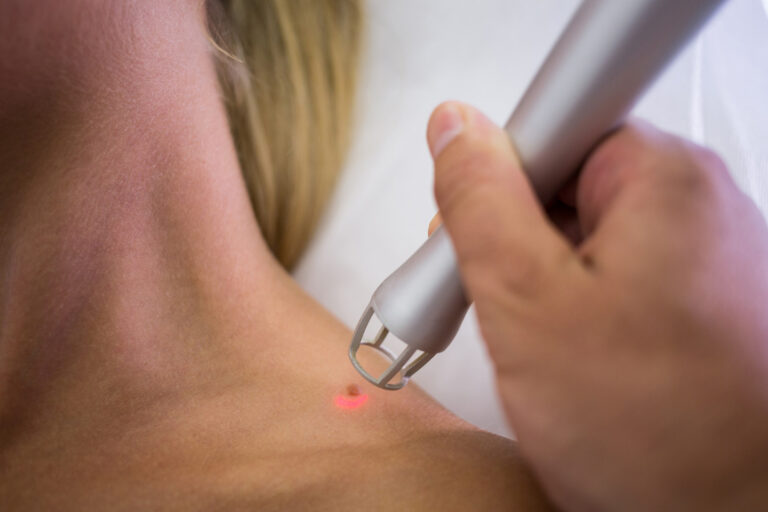
Milia are treated with a simple in-office procedure: Dr. Weiss uses a laser to destroy the keratin contents. The procedure takes minutes, is virtually painless, and produces immediate cosmetic improvement with no downtime.
What to Expect at Your Trillium Clinic Appointment
At your consultation, Dr. Weiss will examine the lump carefully, take a relevant history: how long it has been present, whether it has changed, any prior treatments, and provide a clinical diagnosis. In most cases, a diagnosis can be made on examination alone. When uncertainty exists, a biopsy can be performed and sent to a dermatopathology laboratory for confirmation.
Whether you’re seeing a dermatologist in Chapel Hill, NC, or seeking care through medical dermatology in Chapel Hill, the goal is the same: establishing an accurate diagnosis before recommending treatment.
If excision is appropriate, it can often be scheduled in-office at your convenience. The procedure is performed under local anesthesia, is well-tolerated, and requires no hospital admission. Most patients return to normal activities the same day. For patients considering skin cyst removal, this in-office approach can make treatment convenient while allowing the procedure to be tailored to the specific cyst and its location.
Book Your Appointment at Trillium Clinic
Trillium Clinic Dermatology, led by Dr. Stefan C. Weiss, MD, FAAD, serves patients throughout North Carolina from convenient locations in Chapel Hill, Smithfield, and Burlington, NC. With over 20 years of experience in medical and surgical dermatology, Dr. Weiss brings precision, expertise, and a patient-centered approach to every procedure. For patients seeking skin cyst removal in Chapel Hill, NC, or skin cyst removal in Burlington, NC, Trillium provides expert evaluation and treatment based on the type, location, and condition of the cyst.
If you have a lump under your skin that concerns you, whether it’s been there for years or appeared recently, don’t wait to have it evaluated. Most cysts are completely benign, and when treatment is needed, the procedures available at Trillium Clinic are safe, effective, and designed to get you back to your life quickly. Whether you’re looking for a cyst removal specialist in Chapel Hill, a cyst removal clinic in Chapel Hill or Burlington, or a dermatologist in Burlington, NC, a professional evaluation is the first step toward determining the right treatment.
Trillium also provides medical dermatology in Chapel Hill for patients with a wide range of skin concerns, with personalized care from a board-certified dermatologist. Call, text, or book online to schedule your consultation today.
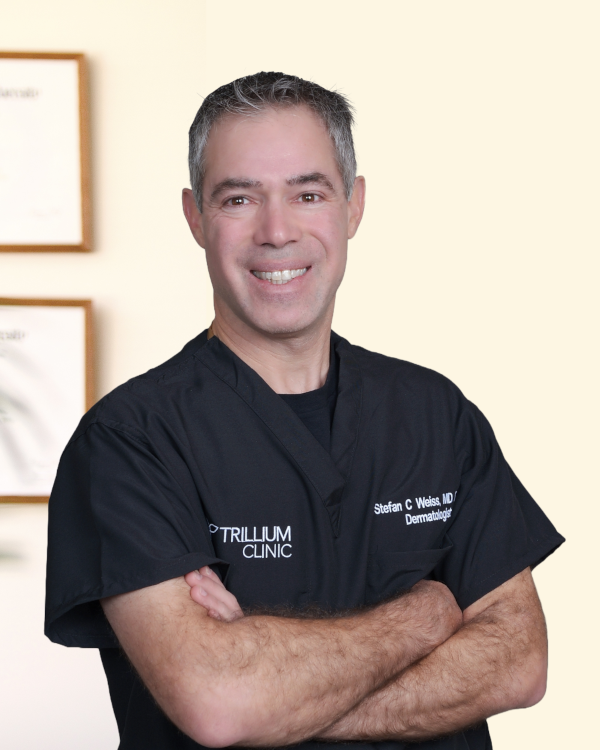
Stefan C. Weiss, MD, FAAD, is a board-certified dermatologist and founder of Trillium Clinic Dermatology. He earned his medical degree from Duke University School of Medicine and completed his residency at Stanford University Medical Center. He is a Fellow of the American Academy of Dermatology.
Frequently Asked Questions About Skin Cyst Removal
You should have a dermatologist evaluate a cyst if it is growing, painful, red, warm, draining, changing in appearance, or located somewhere cosmetically sensitive. An evaluation can confirm whether it is actually a cyst and whether skin cyst treatment or removal is appropriate.
Yes. Epidermoid cyst removal through complete surgical excision removes the cyst wall as well as its contents, which helps reduce the chance of recurrence. Simply draining an inflamed cyst does not remove the wall and is not considered definitive treatment.
No. Small, stable, and asymptomatic cysts can often be monitored. Skin cyst removal may be recommended when a cyst becomes painful, inflamed, infected, larger, or cosmetically bothersome, or when its diagnosis is uncertain.
Yes. Trillium Clinic provides evaluation and treatment for skin cysts at its Chapel Hill and Burlington locations. If you're searching for skin cyst removal in Chapel Hill, NC or skin cyst removal in Burlington, NC, the appropriate first step is a professional evaluation to determine what the lump is and which treatment is appropriate.
Treatment depends on the type and condition of the cyst. Options may include observation, incision and drainage for an inflamed or infected cyst, corticosteroid injection for some mildly inflamed cysts, or complete surgical excision for definitive removal. Skin cyst treatment is tailored to the diagnosis, location, and individual circumstances.