Vascular Laser Treatment For Acne: Risks, Benefits & Care
Vascular laser treatment for acne may be considered for selected patients, but results vary, and laser treatments rarely clear acne on their own.
Acne is the most common skin condition in the United States, affecting up to 50 million Americans annually, according to the American Academy of Dermatology. Yet despite how prevalent it is, it remains one of the most undertreated, not because solutions don’t exist, but because many patients simply don’t know what’s available to them beyond the medicine cabinet.
At Trillium Dermatology, laser-based treatments are among the options I consider for selected patients. Whether the goal is addressing selected inflammatory acne concerns, reducing the redness that lingers after acne clears, or improving the appearance of pitted or rolling scars, the right approach depends on what needs treatment. Two technologies in particular – vascular lasers and fractional CO2 laser resurfacing – work in different ways. Understanding how each works, and when each is appropriate, helps patients make informed decisions.
The Two Problems Acne Creates, and Why They Need Different Solutions
To understand why two different laser platforms are relevant to acne, it helps to understand that acne creates two distinct problems.
The first is the acne itself: the clogged pores, the bacterial overgrowth, the inflammation, the active lesions. This is acne as a disease process – one that needs to be controlled. While laser treatment for acne may be an option for selected patients, the appropriate treatment depends on the type and severity of their acne.
The second is what acne leaves behind: discoloration, persistent redness, and most significantly, scarring. Post-inflammatory erythema (PIE), those flat red or pink marks that linger after a pimple heals, is a vascular-related concern. Post-inflammatory hyperpigmentation (PIH), the dark brown or gray spots that can be more noticeable in medium to deep skin tones, is a pigment-related change. These marks are different from indented acne scars and may require different treatment approaches.
Acne scars, the icepick, boxcar, and rolling depressions in the skin’s surface, are a structural problem involving changes to the skin’s underlying tissue and collagen. Treatments such as CO2 laser resurfacing may help improve the appearance of selected acne scars, depending on their type, depth, and the patient’s skin.
Vascular lasers and CO2 lasers address different concerns. Vascular laser treatment for acne may be considered for selected redness-related concerns, while CO2 laser treatment for acne scars focuses on improving skin texture and the appearance of depressed scarring. The right approach depends on what needs treatment, the patient’s skin, and their goals.
Vascular Lasers for Acne: Treating the Root Cause and the Redness Left Behind
Vascular lasers, most commonly the Excel V operating at 532 and 1064 nm, have been used in dermatology for decades, primarily to treat blood vessel abnormalities. Their use for acne has also been studied, particularly for inflammatory lesions, although results vary by laser type and treatment protocol.
First, the Excel V selectively destroys the microvasculature that feeds inflamed acne lesions. Acne papules and pustules are highly vascular; that’s the biological source of the redness and warmth associated with inflammation. When the laser targets and collapses those feeding vessels, it deprives the lesion of the blood supply that sustains it. Multiple studies have demonstrated that vascular laser treatment reduces both the number and severity of inflammatory acne lesions, and that the effects persist well beyond the treatment period.
Second, the vascular laser has a well-documented anti-inflammatory effect. It modulates cytokine activity in the skin and reduces the bacterial burden of Cutibacterium acnes, the organism primarily responsible for inflammatory acne. This dual mechanism, destroying vascular supply while reducing inflammation, gives vascular laser treatment an advantage that topical and oral therapies don’t share: it addresses acne at the tissue level rather than just systemically or on the surface.
For patients who are candidates for isotretinoin but hesitant about systemic side effects, or for whom oral antibiotics are no longer providing adequate control, vascular laser acne treatment may be considered as part of an individualised treatment plan. It should not, however, be presented as a proven substitute for prescribed systemic treatment. It may also be considered alongside topical retinoids or topical antimicrobial regimens when a dermatologist determines that the combination is appropriate.
Beyond active acne, the vascular laser may help improve post-inflammatory erythema; those persistent pink and red flat marks that can linger for six to twelve months after breakouts resolve. PIE is associated with lingering vascular changes following inflammation. Although vascular laser treatment can improve redness in some patients, there is no universally established gold-standard laser or guaranteed number of sessions. For patients who feel they “always look like they have acne” even during clear periods, improving persistent redness may be an important part of addressing the visible aftermath of acne.
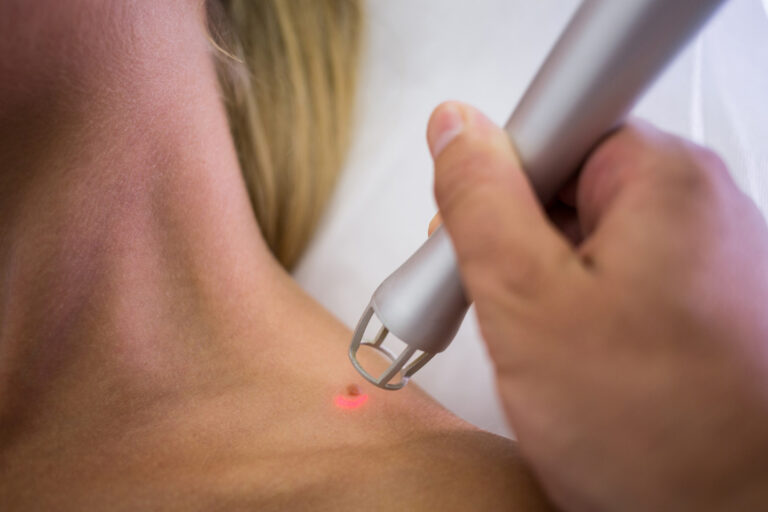
A typical vascular laser session for acne or PIE takes fifteen to thirty minutes, depending on the area being treated. Most patients experience mild redness for twenty-four to forty-eight hours, although recovery varies and temporary swelling or bruising may occur. The dermatologist should explain the likely downtime and aftercare based on the treatment settings and the patient’s skin.
Fractional CO2 Laser for Acne Scars: Rebuilding What Acne Destroyed
If vascular laser treatment may be considered for selected redness-related concerns after acne, fractional CO2 laser resurfacing addresses a different problem: the structural changes associated with scarring. This approach to CO2 laser treatment for acne scars is designed to improve the appearance of depressed scars and uneven skin texture.
Acne scars form when the inflammation of a severe breakout damages dermal collagen. The skin attempts to repair itself, but often incompletely, leaving behind depressions in the surface. These can range from narrow, deep icepick scars to broader, flat-bottomed boxcar scars to shallow, wavelike rolling scars that cast shadows and alter the skin’s contour. Topical products alone generally cannot meaningfully correct depressed acne scars because the damage involves the skin’s underlying structure.
Fractional CO2 laser resurfacing works by delivering precise columns of CO2 laser energy into the skin, creating controlled micro-injuries that trigger the skin’s wound-healing response. Unlike fully ablative CO2 resurfacing, which treats the entire surface within the treatment area, fractional delivery leaves tissue between treatment columns intact. This can shorten healing time while preserving the collagen stimulation that makes CO2 resurfacing an option for selected acne scars.
The remodeling that follows treatment is the key mechanism. Over three to six months after each session, collagen remodeling continues as the skin heals. Scar depressions may become less pronounced, and surface texture may improve gradually. Pores may also appear less noticeable. The degree of improvement varies depending on scar type, severity, treatment settings, and individual healing.
Rolling scars frequently benefit from subcision performed prior to laser resurfacing – a minor in-office procedure using a needle to break the fibrous bands that tether the scar to underlying tissue. Once the scar is released, fractional CO2 resurfacing can help improve the skin’s surface. Combining procedures may be useful when different features of acne scarring require different approaches; the treatment plan should be tailored to the individual.
A fractional CO2 session for acne scarring involves topical numbing for thirty to forty-five minutes beforehand. The treatment itself takes thirty to sixty minutes, depending on the area treated. Downtime is real: patients can expect around seven to fourteen days of redness, swelling, and rough texture as the treated skin heals, although recovery varies with treatment intensity. The skin may be ready for light coverage makeup after approximately one to two weeks, depending on healing and the dermatologist’s advice. Results continue to develop over several months, and some patients with moderate to severe acne scarring may benefit from multiple sessions. The number and spacing of treatments depend on the scars, the laser settings, and the patient’s response.
Who Is a Candidate, and When to Start
One of the most important decisions in laser acne treatment is timing. For active acne, vascular laser treatment may be an option for selected patients, but its suitability depends on the type and severity of acne and the dermatologist’s assessment. For post-inflammatory erythema (PIE), treatment timing also depends on the skin’s condition and the extent of lingering redness; results vary from patient to patient.
For acne scar treatment with CO2, the most important prerequisite is that active acne is adequately controlled. Treating scarring while active breakouts continue can be counterproductive, as ongoing inflammation may contribute to further scarring. Once acne is well-managed, whether through topical therapies, oral medications, or other appropriate acne treatments, scar revision with fractional CO2 laser resurfacing may be considered.
Skin type matters considerably in laser selection and settings. Patients with darker skin tones (Fitzpatrick types IV–VI) may face a higher risk of post-inflammatory pigmentation changes with certain laser procedures, particularly when aggressive settings are used. In my practice, I adjust settings carefully for each patient’s skin type and may incorporate a pre-treatment course of topical brightening agents to minimize pigmentation risk. This is an area where working with an experienced dermatologist, rather than a medi-spa, makes a meaningful difference in both safety and outcomes.
What Laser Treatment Can and Cannot Do
I want to be straightforward with every patient: laser treatment is powerful, but it is not a cure for acne, and it does not erase scars completely. Active acne requires ongoing management; stopping that management allows acne to recur and create new damage. The goal of acne scar treatment is significant improvement, rather than complete elimination. The degree of improvement varies with scar type, severity, treatment choice, and individual response, so a specific percentage cannot be guaranteed for every patient.
What I can say with confidence, after years of using these technologies, is that for the right patients, the results are genuinely life-changing. Patients who have avoided cameras, worn heavy makeup as armor, or declined social invitations because of their skin tell me, consistently, that scar treatment changed something fundamental about how they move through the world. That’s not a minor outcome. That’s the whole point.
If you’re living with acne, acne redness, or acne scars, a consultation at Trillium Dermatology will give you a clear picture of what’s possible for your specific skin. You don’t have to keep waiting for things to improve on their own.
FAQs
Vascular lasers primarily target visible redness and blood vessels, making them an option for selected red acne marks and vascular concerns. Fractional CO2 laser resurfacing targets textural changes and selected depressed acne scars by stimulating collagen remodeling. The right choice depends on whether the main concern is redness, uneven texture, or scarring.
No. Laser treatment for acne may be considered for selected patients, but it should not automatically replace established topical or oral treatments. Vascular laser acne treatment may form part of an individualized plan, depending on the acne type and treatment goals. A dermatologist can assess which options are appropriate alongside medical acne treatments at Trillium Clinic.
No. CO2 laser resurfacing for acne scars may improve the appearance of selected depressed scars and uneven skin texture, but results depend on scar type, depth, skin type, and treatment settings. Some rolling scars may benefit from subcision before resurfacing. The goal of acne scar resurfacing is improvement, not complete scar removal.
A vascular laser for acne scars may help reduce associated redness in suitable patients, but it does not correct the underlying depressions or fibrous bands responsible for certain scars. Those structural concerns may require a different acne scar treatment, such as fractional CO2 laser resurfacing. Your dermatologist can explain the options during a consultation for vascular laser treatment or CO2 laser resurfacing.
Trillium Clinic offers vascular laser treatments and CO2 laser resurfacing at its Chapel Hill location. Patients considering laser treatment for acne scars in Chapel Hill, NC, can consult Dr. Stefan Weiss to discuss their skin, scar type, treatment goals, and potential recovery time. The consultation can help determine whether vascular laser treatment, CO2 laser resurfacing, or another approach is appropriate.
Dr. Stefan Weiss is a board-certified dermatologist and founder of Trillium Dermatology. To schedule a laser consultation for acne or acne scarring, schedule an appointment or visit trilliumclinic.com.