Last updated: October 21, 2026
There’s no single best treatment for vertical lip lines. The right choice depends on what’s causing them. Fillers support thin skin and soften etched lines, small doses of Botox relax the muscle that puckers the lips, and CO2 laser or microneedling rebuild collagen in the skin itself. For most people, a combination gives the smoothest, most natural result.
This guide compares each option, what results to expect and how to decide. If you want to know why lip lines form and how to slow them down at home, see our guide to smoker’s lines and how to prevent them.
Quick answers
| Question | Short answer |
|---|---|
| What’s the best treatment for fine lip lines? | A filler placed into the lines, or a light resurfacing treatment |
| What’s best for deeper, etched-in lines? | CO2 laser, often combined with filler |
| What if the lines get worse when I pucker? | A small dose of Botox or Xeomin, usually with filler |
| Which works fastest? | Filler: results are visible almost immediately |
| Which lasts longest? | CO2 laser: results can last years with maintenance |
| Can lines be treated at home? | Skincare can soften fine lines and slow new ones, but etched lines need in-office treatment |
Treatments for vertical lip lines compared
| Dermal fillers | Botox or Xeomin | CO2 laser | Microneedling | |
|---|---|---|---|---|
| How it works | Fills lines and supports thin skin | Relaxes the muscle that puckers the lips | Resurfaces the skin and builds collagen | Tiny channels trigger new collagen |
| Best for | Fine and moderate lines, thinning lips | Lines that deepen when you pucker | Etched-in lines, sun damage, crepey skin | Fine lines and texture |
| When you see results | Almost immediately | Most people within 3–7 days | Smoother at about 2 weeks; improves for 3–6 months | After about 4–6 weeks |
| How long results last | About 6–12 months, depending on the filler | About 3–4 months | Years, with annual maintenance | Builds over a series |
| Downtime | Minimal | Little to none | About 7–10 days; up to 2 weeks for deeper treatments | About 2–7 days |
| Sessions | Usually one, then top-ups | Repeat every few months | Results often after one session; a series of 3 for the most significant results | A series, usually monthly |
Sources: AAD botulinum toxin overview, AAD fillers overview, ASDS microneedling, ASPS laser recovery.
Fillers for vertical lip lines
Hyaluronic acid fillers, such as Juvederm and Restylane, are one of the most popular treatments for lip lines. A small amount can be placed directly into fine lines to smooth them, or along the lip border to restore support that has thinned with age. The American Academy of Dermatology notes that fillers can erase fine lines and plump lips, and most people return to everyday activities right away. Some hyaluronic acid fillers, including Restylane Silk and Juvéderm Volbella XC, are FDA-approved specifically for correcting lines around the mouth in adults over 21.
Results are visible almost immediately and typically last about 6–12 months, depending on the product. The aim is softer lines, not bigger lips. See our dermal fillers page for more.
Botox for lip lines
Lip lines are partly caused by the muscle that purses the lips. A very small dose of Botox or Xeomin can relax that muscle, so lines soften and form more slowly. Most people see results within 3–7 days, and they last about 3–4 months.
The area around the mouth needs precise dosing so you can still speak, drink and smile normally. Using Botox around the lips isn’t one of its FDA-approved cosmetic uses, so an experienced injector matters. It works best combined with filler or resurfacing.
Laser resurfacing for lip lines
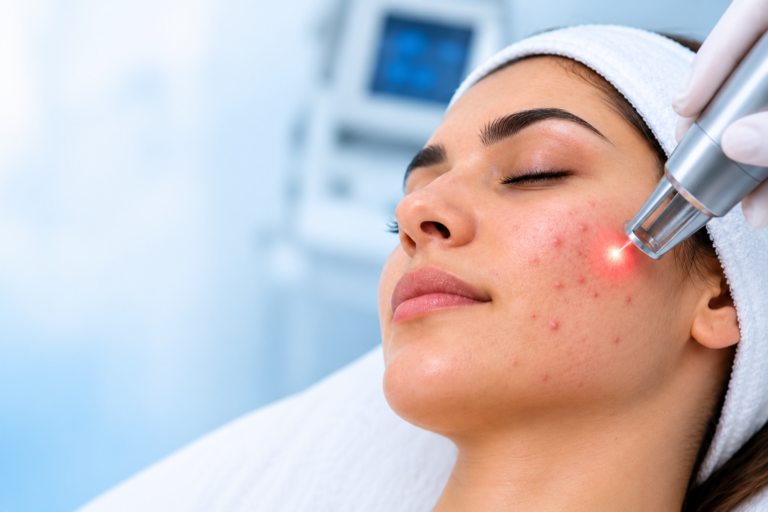
Fractional CO2 laser is often the strongest option for lines that are etched in by years of sun damage and collagen loss. It removes a thin layer of damaged skin and heats the skin underneath, so new collagen forms and lines soften gradually over 3–6 months. In a study of 25 women published in the British Journal of Dermatology, wrinkles were significantly reduced in every facial area measured, including around the mouth, after three fractional CO2 treatments.
Expect about 7–10 days of redness, swelling and peeling, and up to 2 weeks for deeper treatments. Results are often achieved in one session; a series of 3 is typically recommended for the most significant results. Read more in our guide to CO2 laser for wrinkles, and see how it compares with gentler options in our CO2 laser comparison.
Microneedling for lip lines
Microneedling uses fine needles to make tiny channels in the skin, which triggers new collagen and elastin. It’s often combined with PRP. Downtime is shorter than laser, usually 2–7 days, and the American Society for Dermatologic Surgery notes it can be done on any skin color. Results appear after about 4–6 weeks and build over a series of monthly treatments. The ASDS shows a patient’s lip lines three months after two microneedling sessions.
Why a combination often works best
Most lip lines have more than one cause: muscle movement, thinning support and sun-damaged skin. Treating only one usually gives only part of the result. A common plan uses Botox for movement, filler for support and CO2 laser or microneedling for the skin. Dr. Weiss sets the order and timing at your consultation.
How to choose
- Fine lines, little downtime: filler or microneedling
- Lines that deepen when you pucker: a small dose of Botox with filler
- Deep, etched-in lines and sun damage: CO2 laser, often with filler
- Darker skin: microneedling or a gentler laser setting may be safer; ask at your consultation
Book a consultation
“Everyone was so friendly and worked so well as a team to make me feel comfortable and listened to my concerns.”
— Rickey M., Trillium Clinic patient (read more reviews)
Dr. Weiss and the team will look at what’s causing your lip lines and recommend filler, Botox, laser, microneedling or a combination. Schedule a consultation online or call 919-710-8100. Consultations are available at all three Trillium offices: Chapel Hill, Smithfield and Burlington.
Frequently asked questions
It depends on the cause. Filler is often best for fine lines and thinning lips, Botox for lines that deepen when you pucker, and CO2 laser for deep, etched-in lines. Many people get the best result from a combination.
Fractional CO2 laser is one of the most effective lasers for etched-in lip lines, because it resurfaces the skin and builds new collagen. It has about 7–10 days of downtime.
Hyaluronic acid filler for lip lines typically lasts about 6–12 months, depending on the product and your skin.
A small dose of Botox can soften lines caused by puckering and slow new ones from forming, but it doesn't fill lines that are already etched in. It works best with filler or resurfacing.
Filler gives the quickest result, usually visible right away with minimal downtime.
It doesn't have to. Filler for lip lines uses small amounts placed to soften lines and support the skin, not to change lip size.
About Dr. Weiss
Stefan C. Weiss, MD, FAAD, is a board-certified dermatologist, the medical director of Trillium Clinic and an adjunct professor of dermatology at Brown University. He trained at Duke University School of Medicine and Stanford University Medical Center, has authored more than 100 peer-reviewed abstracts, posters and manuscripts, and has over two decades of experience in medical and cosmetic dermatology.
References
- American Academy of Dermatology. Fillers: Overview.
- American Academy of Dermatology. Botulinum toxin therapy: Overview.
- U.S. Food and Drug Administration. Restylane Silk: Summary of Safety and Effectiveness Data (approved June 13, 2014).
- U.S. Food and Drug Administration. Juvéderm Volbella XC premarket approval (P110033/S018).
- Kohl E, et al. Fractional carbon dioxide laser resurfacing of rhytides and photoageing: a prospective study using profilometric analysis. British Journal of Dermatology. 2014;170(4):858–865.
- American Society for Dermatologic Surgery. Microneedling.
- American Society of Plastic Surgeons. Laser skin resurfacing recovery.
This article is for general education and isn’t a substitute for personal medical advice. A board-certified dermatologist can tell you which treatment is right for you.