Basal Cell Carcinoma vs Squamous Cell Carcinoma Explained
Basal cell carcinoma vs squamous cell carcinoma is an important distinction because these are the two most common types of skin cancer in the United States. Together, they are called nonmelanoma skin cancers. Both are usually caused by years of ultraviolet (UV) exposure, and both are highly treatable when found early.
They are not the same disease, though. They look different, grow differently, and carry different levels of risk. Knowing the difference can help you recognize a spot that needs attention and understand your options if you receive a diagnosis.
What Is Basal Cell Carcinoma?
Basal cell carcinoma starts in the basal cells, which sit in the deepest layer of the epidermis. It is the most common type of skin cancer.
Where it appears: Most often on sun-exposed skin such as the face, nose, ears, scalp, neck, and shoulders.
How it may look:
- A shiny, pearly, or translucent bump
- A pink or red patch that may be slightly scaly
- A sore that bleeds, scabs, heals, and then returns
- A flat, scar-like area with poorly defined edges
- A bump with a rolled border and tiny visible blood vessels
How it behaves: BCC usually grows slowly and very rarely spreads to other parts of the body. However, it can grow deeper and wider over time and damage the skin, cartilage, and even bone around it. That is why a BCC on the nose or near the eye still needs prompt treatment.
What Is Squamous Cell Carcinoma?
Squamous cell carcinoma starts in the squamous cells, which make up the upper layers of the skin. SCC can develop from actinic keratoses, the rough, scaly precancerous spots that are common on sun-damaged skin.
Where it appears: Most often on the face, ears, lips, scalp, backs of the hands, forearms, and lower legs.
How it may look:
Common squamous cell carcinoma symptoms include:
- A rough, scaly red patch
- A firm, raised bump, sometimes with a central crust
- A wart-like growth
- An open sore that does not heal
- A spot that is tender or painful to the touch
How it behaves: SCC can grow faster than BCC and carries a higher risk of spreading, especially when it is large, deep, recurrent, or located on the lip or ear. People with weakened immune systems, including organ transplant recipients, can develop more aggressive SCCs.
Key Differences at a Glance
The main differences between basal vs squamous cell carcinoma include their appearance, growth rate, risk of spreading, and common locations.
Basal Cell Carcinoma | Squamous Cell Carcinoma | |
|---|---|---|
Typical look | Pearly bump, pink patch, non-healing sore | Scaly red patch, firm bump, crusted sore |
Growth rate | Usually slow | Can grow faster than BCC |
Risk of spreading | Very low | Low but higher than BCC |
Precursor | Usually none | Often actinic keratosis |
Common locations | Face, nose, ears, neck | Face, lips, ears, hands, forearms, legs |
Shared Risk Factors
BCC and SCC share many of the same risk factors:
- Cumulative sun exposure and past sunburns
- Tanning bed use
- Fair skin, light eyes, or skin that burns easily
- Older age
- A weakened immune system
- A personal history of skin cancer
Having one nonmelanoma skin cancer raises your chance of developing another. That makes regular skin exams an important part of long-term care.
How Dermatologists Diagnose BCC and SCC
You can’t reliably tell BCC and SCC apart just by looking at them, and you can’t rule out skin cancer that way either. Diagnosis usually involves three steps:
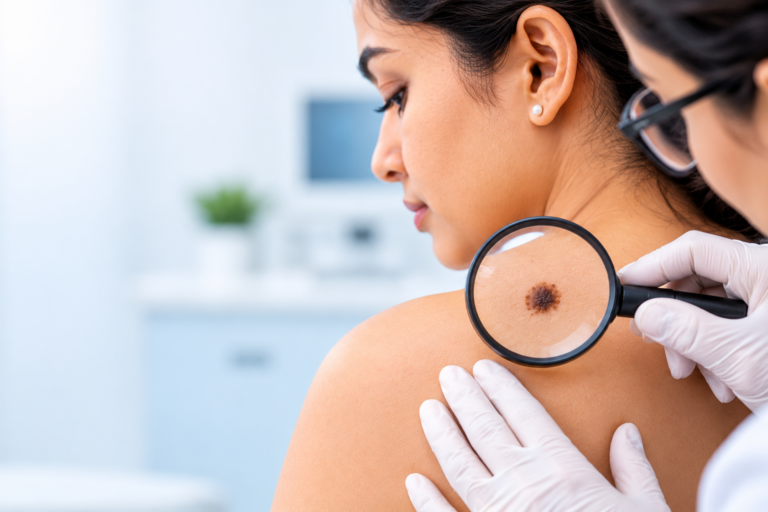
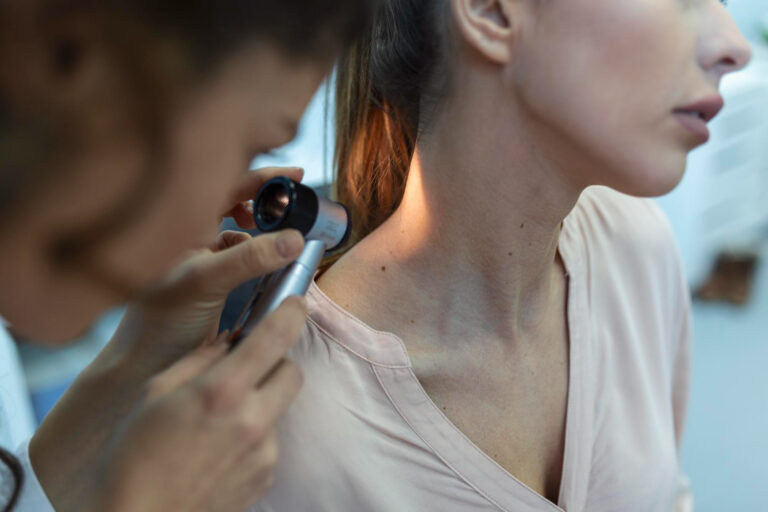
- Skin exam: Your dermatologist examines the spot, often with a dermatoscope, a lighted magnifying tool.
- Biopsy: A small sample is removed after the area is numbed.
- Pathology: A dermatopathologist examines the tissue under a microscope to confirm the diagnosis and identify the subtype, which helps guide treatment.
Treatment Options
Treatment depends on the cancer type, size, subtype, location, and your overall health. Options include:
- Surgical excision: Removing the tumor with a margin of healthy skin.
- Mohs surgery: A precise, layer-by-layer technique with same-day microscopic margin checks, often used on the face and in high-risk cases. Mohs surgery is available at Trillium’s Chapel Hill office.
- Electrodesiccation and curettage (ED&C): Scraping and cauterizing selected small, low-risk tumors.
- Topical treatments: Prescription creams for selected superficial BCCs or SCC in situ.
- Other options: Radiation or other therapies for patients who are not good surgical candidates.
To learn whether Mohs is the right choice for a particular tumor, see our guide: Mohs Surgery: The Gold Standard for Skin Cancer Removal.
Skin Cancer Evaluation and Treatment Near You
Dr. Stefan Weiss and the Trillium Clinic Dermatology team diagnose and treat basal cell and squamous cell carcinoma for patients across the Triangle and eastern Piedmont. You can be evaluated and discuss treatment options at any of our three offices:
- Chapel Hill, convenient for patients from Durham, Cary, Hillsborough, and western Raleigh.
- Burlington, serving Mebane, Graham, and Alamance County.
- Smithfield, serving Clayton, Goldsboro, Garner, and Johnston County.
When Mohs surgery is the best option, the procedure is performed at our Chapel Hill office. Your treatment plan is built around the care you need, wherever your consultation took place.
Frequently Asked Questions
Squamous cell carcinoma is generally considered more serious because it has a higher risk of spreading than BCC. That said, an untreated BCC can cause significant local damage. Both should be evaluated and treated promptly.
No. BCC and SCC come from different skin cells and are separate cancers. Some rare tumors show features of both, and a person can develop both types over time. Your pathology report will specify exactly which type you have.
Not always. Surgery is the most common treatment, but selected low-risk SCCs may be treated with other approaches, such as ED&C. Topical therapy may be an option for SCC in situ. Your dermatologist will recommend a treatment based on the tumor's size, depth, and location.
Yes. Mohs surgery is commonly used for both, especially for tumors on the face, ears, and lips, where preserving healthy tissue matters, and for recurrent or aggressive tumors.