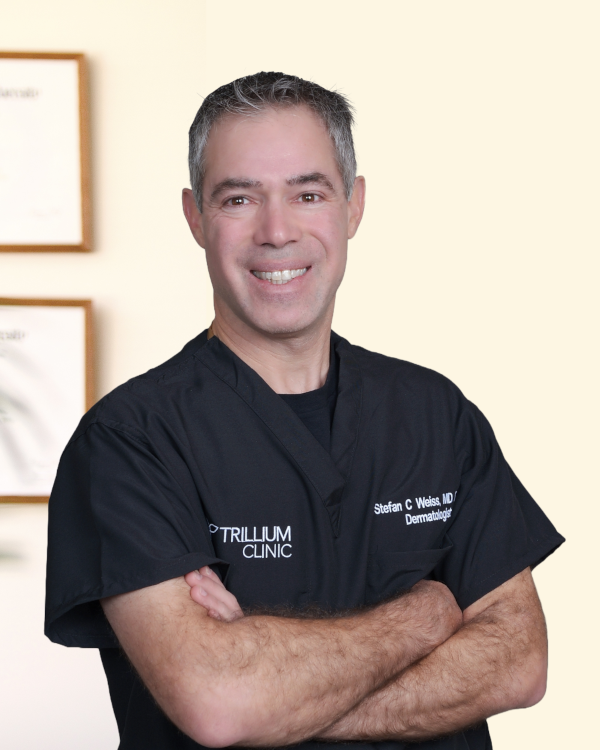
Expert Skin Care Advice for Men From Dr. Stefan Weiss
A dermatologist for men can help identify and treat skin conditions long before they become more serious. Let’s be honest. Most men don’t think about their skin until something goes wrong. A mole that’s been changing for months finally gets mentioned, almost as an aside, at a routine physical. A rash that’s been present for a year gets Googled, self-diagnosed, and treated with whatever’s under the bathroom sink. An itchy spot on the scalp gets attributed to shampoo. The appointment with a dermatologist? That gets scheduled eventually. Someday. When there’s time or the wife demands it.
This is a pattern Dr. Stefan Weiss sees regularly at Trillium Clinic Dermatology, and it’s one worth interrupting. Because the dermatologic risks men face are real, the consequences of delayed care are measurable, and the solutions available at Trillium Clinic are straightforward. The barrier, in most cases, isn’t access or cost. It’s the widespread belief among men that skin care is something other people need.
At Trillium Clinic Dermatology, we provide comprehensive dermatology in Chapel Hill for men of all ages, from preventive skin cancer screenings and acne treatment to hair loss evaluation and cosmetic dermatology. The earlier a concern is evaluated, the more treatment options are typically available and the better the long-term outcomes can be.
It isn’t. Here’s why.
Men and Skin Cancer: The Numbers Are Stark
Skin cancer is the most common cancer in the United States, and men bear a disproportionate share of the burden. Skin cancer in men is diagnosed more frequently than in women, particularly melanoma, the deadliest form of skin cancer. Men are diagnosed with melanoma at nearly twice the rate of women. More critically, men die from melanoma at nearly twice the rate of women. That gap is not explained by biology alone. It is explained, in large part, by delayed presentation. Men wait longer to have changing moles evaluated. They are less likely to perform self-examinations. And they are far less likely to have a dermatologist at all.
Experienced dermatologists perform comprehensive skin cancer screenings and full-body skin examinations that cover the entire skin surface: including the scalp, ears, back, and soles of the feet, which are areas men frequently miss on self-exam and which represent common sites for melanoma to develop undetected. A full-body skin exam takes less than fifteen minutes. It is painless. And for men with significant sun exposure history, fair skin, a family history of skin cancer, or a large number of moles, it can genuinely be life-saving.
If you’re looking for skin cancer screening in Chapel Hill, early evaluation by a board-certified dermatologist can help identify suspicious lesions before they become more difficult to treat.
Caught early, melanoma is highly curable, with five-year survival rates above 98% for localized disease. Caught late, after it has spread to lymph nodes or distant organs, the prognosis changes dramatically. The difference between those two scenarios is often nothing more than whether a patient had an annual skin check.
Basal Cell and Squamous Cell Carcinoma: The "Common" Cancers That Still Require Attention
While melanoma commands the most concern, basal cell carcinoma (BCC) and squamous cell carcinoma (SCC) are far more common, and men develop both at significantly higher rates than women. This is partly a matter of cumulative sun exposure: men spend more time outdoors for work and recreation, are less consistent with sunscreen use, and historically have had less access to sun-protective clothing and habits.
BCC and SCC most commonly develop on sun-exposed areas: the face, ears, scalp (particularly in men with thinning hair), neck, forearms, and hands. They rarely look dramatic. BCC often presents as a pearly, translucent bump or a flat, scar-like lesion that won’t heal. SCC may appear as a rough, scaly patch that bleeds or crusts intermittently. Men commonly attribute these lesions to a nick from shaving, a dry patch, or a “spot that comes and goes.” They are not.
An expert dermatologist evaluates and treats BCC and SCC using surgical excision, electrodessication and curettage, and, for appropriate lesions, non-surgical options including topical therapies. When Mohs surgery is indicated, they will schedule and perform the procedure in the Chapel Hill location, with the patient’s cosmetic outcome and treatment experience as central priorities.
Acne Doesn't End at 25
One of the most persistent myths in dermatology is that acne is a teenage problem. Adult acne affects a significant proportion of men well into their thirties, forties, and beyond; often presenting differently than adolescent acne, with deeper, more inflammatory nodules and cysts concentrated along the jaw, neck, and back. Left untreated, adult acne causes scarring that is far more difficult and expensive to address than the acne itself.
Men with persistent acne frequently try a rotation of over-the-counter products with limited results before resigning themselves to living with the condition. Board-certified dermatologists offer a full range of evidence-based treatments for adult male acne: prescription topical retinoids, oral antibiotics, and in-office procedures including chemical peels and lasers. Patients looking for a dermatologist for acne in men benefit from an individualized treatment plan, because the most effective approach depends on the pattern, severity, and underlying causes of the acne. The right combination depends on the pattern and severity of the acne, which is exactly why a professional evaluation matters more than another trip to the drugstore.
Early treatment not only helps control active breakouts but can also reduce the risk of permanent acne scarring, making timely dermatologic care especially important for adult men.
Hair Loss: More Treatable Than You Think
Male pattern hair loss: androgenetic alopecia, affects roughly 50% of men by age 50 and a significant proportion well before that. Most men assume hair loss is inevitable and untreatable, which is not accurate. There are FDA-approved treatments that slow hair loss and in many cases stimulate meaningful regrowth, particularly when started early.
Your dermatologist evaluates men with hair loss carefully, distinguishing androgenetic alopecia from other causes such as alopecia areata, telogen effluvium triggered by illness or nutritional deficiency, or scarring alopecias that require prompt intervention to prevent permanent follicle loss. A dermatologist for hair loss in men can identify the underlying cause before recommending treatment, since not every form of hair loss responds to the same therapy. Treatment options include topical minoxidil, finasteride, exosome therapy, and low-level laser therapy. For men who have waited and lost significant density, a frank conversation about realistic expectations and combination strategies is always part of the consultation at Trillium Clinic.
The one consistent message: the earlier hair loss is addressed, the more options are available and the better the outcomes tend to be.
Rashes, Infections, and Chronic Skin Conditions Men Ignore
Men tend to tolerate skin conditions that most dermatologists would consider eminently treatable. A few deserve specific mention. Routine men’s skin care isn’t just about preventing dryness or looking younger; it also means recognizing persistent skin conditions early and seeking the right treatment before they become more difficult to manage.
Tinea (fungal infections): Athlete’s foot, jock itch, and onychomycosis (nail fungus) are extremely common in men and are frequently undertreated with over-the-counter antifungals that don’t penetrate deeply enough to clear the infection. Prescription oral antifungals, where appropriate, are significantly more effective.
Seborrheic dermatitis: Chronic flaking and redness of the scalp, face, and chest; often mistaken for dandruff or dry skin, is one of the most common conditions dermatologists treat in men. It is a chronic inflammatory condition driven by yeast colonization of the skin, and it responds well to targeted prescription treatment.
Psoriasis: Affecting roughly 3% of the population, psoriasis is a chronic immune-mediated condition that causes thick, scaly plaques on the elbows, knees, scalp, and elsewhere. Many men with psoriasis are undertreated, living with significant skin involvement when highly effective therapies, including targeted biologics, are available. An experienced psoriasis specialist can give you access to the full range of modern treatments.
Eczema: Adult eczema in men is frequently misdiagnosed or dismissed. Chronic itch, dry skin, and recurrent rashes on the hands, arms, and torso can represent atopic dermatitis that responds well to newer targeted therapies including dupilumab.
Cosmetic Concerns Are Legitimate - and Common
Men increasingly seek cosmetic dermatology services, and there is nothing unusual about that. At Trillium Clinic, Dr. Weiss treats men for a range of aesthetic concerns: sun damage and uneven skin tone, deep facial lines, under-eye hollowing, acne scarring, and unwanted hair. Botox, dermal fillers, laser resurfacing, and chemical peels are all part of the menu of services available, and all are performed with the goal of natural-looking, well-rested results rather than dramatic changes. As part of our men’s dermatology services, every treatment plan is individualized to the patient’s skin type, concerns, and long-term goals.
Men who come to Trillium Clinic for cosmetic consultations often remark that the results are more subtle than they expected, in the best possible way. The goal is to look like yourself, refreshed.
The Annual Skin Check: Make It a Habit
If you take away one thing from this article, let it be this: men should have an annual full-body skin examination beginning in their twenties, and sooner if there is a history of significant sun exposure, atypical moles, or a personal or family history of skin cancer. It is the single most impactful thing a man can do for his long-term dermatologic health.
At Trillium Clinic, scheduling a skin check with Dr. Stefan Weiss is straightforward. As a dermatologist for men, Dr. Weiss provides comprehensive skin examinations to help detect skin cancer and other dermatologic conditions early. You will leave with a clear picture of what’s on your skin, what requires monitoring, what needs treatment, and what you can stop worrying about.
Call, text, or schedule an appointment. Whether you’re looking for dermatology in Chapel Hill or a dermatologist in Burlington, NC, our team is here to help you take a proactive approach to your skin health.
Stefan C. Weiss, MD, FAAD, is a board-certified dermatologist and founder of Trillium Clinic Dermatology. He earned his medical degree from Duke University School of Medicine and completed his residency at Stanford University Medical Center. He is a Fellow of the American Academy of Dermatology.
FAQs About Seeing a Dermatologist for Men
Men should see a dermatologist if they notice a changing mole, persistent rash, acne that doesn't improve with over-the-counter products, unexplained hair loss, or any skin concern that lasts more than a few weeks. Even without symptoms, an annual skin examination is recommended for men with significant sun exposure, numerous moles, or a personal or family history of skin cancer.
A dermatologist for men diagnoses and treats a wide range of conditions, including acne, eczema, psoriasis, fungal infections, skin cancer, hair loss, and nail disorders. Dermatologists also provide cosmetic treatments such as Botox, laser procedures, and treatments for acne scars, sun damage, and other signs of skin aging.
Yes. Annual skin examinations are especially important for men because they have a higher risk of developing melanoma and other forms of skin cancer. Regular men's skin cancer screening helps detect suspicious lesions early, when treatment is typically simpler and more effective.
When choosing the best dermatologist for men, look for a board-certified dermatologist with experience treating both common and complex skin conditions. It's also helpful to choose a practice that offers comprehensive care, including medical, surgical, and cosmetic dermatology, so your treatment options can be tailored to your specific needs.
At Trillium Clinic Dermatology, Dr. Stefan Weiss provides personalized, evidence-based care for men of all ages. Whether you need treatment for acne, hair loss, chronic skin conditions, skin cancer screening, or cosmetic concerns, our team offers comprehensive dermatology in Chapel Hill with a focus on early diagnosis, effective treatment, and long-term skin health.