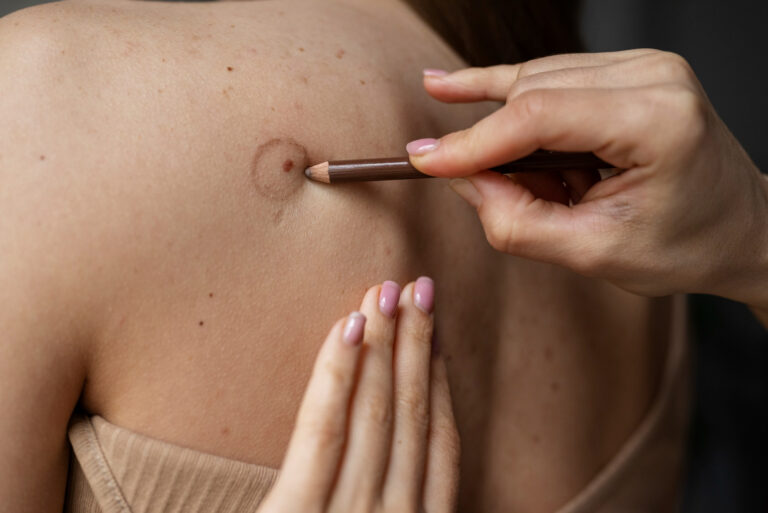
If psoriasis creams are no longer keeping your skin comfortable and clear, you may have more options than you realize. Icotyde (icotrokinra) is a once-daily prescription psoriasis pill that blocks the IL-23 receptor, a target in the immune pathway that drives plaque psoriasis. The FDA approved it on March 17, 2026, for eligible adults and adolescents with moderate-to-severe plaque psoriasis. The current prescribing information explains who qualifies, how to take the medicine and what safety information to review.
At Trillium Clinic, we help patients in Chapel Hill, Smithfield and Burlington understand their psoriasis treatment options. Here is what to know about Icotyde for psoriasis, including who it is approved for, how well it works and what to discuss at your appointment.
Ready to review your treatment? Call 919-710-8100 or schedule a psoriasis appointment.
Psoriasis in brief
Psoriasis is an immune-mediated condition that causes skin inflammation and is not contagious. Plaque psoriasis is the most common form; psoriasis can also affect the scalp and nails, appear in skin folds as inverse psoriasis, or develop as smaller spots in guttate psoriasis. Severity depends on the amount of skin involved, the areas affected and the effect on daily life; visit our psoriasis service page and psoriasis causes and symptoms guide for more detail.
What is Icotyde and how does it work?
Icotyde is the brand name for icotrokinra, a targeted oral peptide and IL-23 receptor antagonist. IL-23 helps sustain the inflammation involved in plaque psoriasis. Some injectable biologics target IL-23 itself; Icotyde blocks its receptor, helping interrupt that inflammatory signal. This is why it is described as an IL-23 receptor-targeting treatment rather than a medicine that blocks IL-23 directly.
Icotyde at a glance
Feature | What patients should know |
FDA approval | March 17, 2026 |
Approved use | Moderate-to-severe plaque psoriasis in adults and adolescents age 12 or older who weigh at least 40 kg, approximately 88 lb, and are candidates for systemic treatment or phototherapy |
How it works | A targeted oral peptide that blocks the IL-23 receptor |
Dose | One 200 mg tablet once daily |
How to take it | Upon waking, with water on an empty stomach; wait at least 30 minutes before eating |
Swallowing difficulties | The tablet can be dispersed in water using the prescribed preparation instructions; ask your pharmacist or dermatologist to explain them |
Most common side effects | Headache, nausea, cough, fungal infection and fatigue |
The FDA label reports safety data from four phase 3 trials involving 2,367 adults and adolescents with moderate-to-severe plaque psoriasis. The broader clinical program also evaluated difficult-to-treat areas, including the scalp and genitals. Approval is specifically for qualifying patients with plaque psoriasis, rather than every type of psoriasis.
How well does Icotyde work for psoriasis?
The phase 3 ICONIC-ADVANCE 1 and 2 trials compared icotrokinra with placebo and deucravacitinib. At week 16, 68% and 70% of participants taking icotrokinra had clear or almost clear skin (IGA 0/1), compared with 11% and 9% of participants taking placebo. PASI 90, which means at least a 90% improvement from baseline in a score combining the extent and severity of psoriasis, was achieved by 55% and 57% of participants taking icotrokinra, compared with 4% and 1% taking placebo. These findings are consistent with Johnson & Johnson’s summary of the ICONIC head-to-head studies. PASI 90 indicates substantial improvement, not necessarily completely clear skin, and individual responses vary.
In ICONIC-ADVANCE 1 and 2, icotrokinra also showed higher response rates than deucravacitinib, the once-daily pill sold as Sotyktu, on the studied skin-clearance endpoints. The trials do not establish that Icotyde works better than injectable biologics.
Across ICONIC-ADVANCE 1 and 2, at least one adverse event was reported through week 16 in 48% of participants taking icotrokinra and 57% of those taking placebo. These figures describe overall adverse events, not the rates of individual adverse reactions listed in the product label. A separate pooled one-year safety analysis reported no safety signals through week 52. That is reassuring trial information, but it does not mean the medicine is risk-free or that every possible long-term risk is known. Treatment selection should account for your medical history as well as your skin.
Icotyde side effects and safety considerations
The most common icotrokinra side effects are headache, nausea, cough, fungal infection and fatigue. Medicines that affect the immune system can increase infection risk. Tell your dermatologist about an infection that persists or keeps returning, a history of tuberculosis or close TB contact, kidney problems, and any recent or planned vaccines. Live vaccines should be avoided during treatment.
Also discuss pregnancy, plans to become pregnant or breastfeeding. The prescribing information states that available pregnancy data are insufficient to evaluate drug-associated risks and that there are no data on icotrokinra in human milk or its effects on a breastfed infant. Your clinician will review your risks and benefits, vaccination needs and whether TB evaluation is appropriate. Moderate or severe kidney impairment requires attention to possible adverse reactions.
If you develop symptoms of an important infection while taking Icotyde, contact your prescriber promptly. Read the full prescribing information and Medication Guide for complete instructions and safety information.
How Icotyde compares with other psoriasis treatments
The best psoriasis medication depends on your symptoms, medical history, treatment goals, insurance coverage and preferred routine. A daily pill may suit one person, while an injection given every few months may be easier for another.
Treatment | How it is taken and how often | Good to know |
Creams and ointments | Applied to affected skin, often once or twice daily, depending on the product | Include corticosteroids and nonsteroid options such as roflumilast and tapinarof; can also supplement systemic treatment |
Phototherapy | Prescribed ultraviolet light, often 2–3 sessions weekly initially | Requires a treatment schedule and access to appropriate equipment |
Icotyde | One pill daily on an empty stomach upon waking | Targets the IL-23 receptor; has age, weight and disease eligibility requirements |
Other oral treatments | Apremilast is usually twice daily; deucravacitinib is once daily | Work through different pathways and have different risks and prescribing considerations |
Injectable biologics | Depending on the drug and treatment phase, dosing may range from twice weekly to every 12 weeks | Include TNF, IL-17, IL-23 and IL-12/23 blockers; selected medications also treat psoriatic arthritis |
This is a brief comparison, not a complete medication list. Read our latest psoriasis treatment options guide and overview of novel topical treatments for psoriasis for more information.
When should you move beyond psoriasis creams?
You do not have to wait until psoriasis covers most of your body to discuss a different treatment. The International Psoriasis Council’s treatment-candidacy framework identifies candidates for systemic treatment based on involvement of 10% or more of body surface area, high-impact sites, or failure of topical therapy. Its updated consensus definition of topical-treatment failure includes not reaching clear or nearly clear skin after two consecutive four-week courses of appropriately used topical treatment. This is a discussion framework, not a requirement to keep using an ineffective treatment without review.
Schedule a reassessment if:
- Plaques keep returning despite using treatment as directed.
- Itching or discomfort interferes with sleep or work.
- Scalp, face, hand, foot, genital or nail symptoms are difficult to control.
- Your treatment routine is too burdensome to maintain, or symptoms affect your confidence and relationships.
Psoriasis is also associated with psoriatic arthritis and cardiovascular and metabolic conditions. These links support looking at your overall health; they do not establish that Icotyde prevents joint disease or heart problems.
If your current psoriasis treatment is falling short, call 919-710-8100 to arrange an evaluation at Trillium Clinic.
Mention joint symptoms early
Tell your dermatologist about joint pain, swelling, morning stiffness or a swollen “sausage” finger or toe. Nail pitting or lifting can also be a clue, although nail changes alone do not diagnose arthritis.
Some medications treat both skin psoriasis and psoriatic arthritis. Icotyde’s current FDA indication is plaque psoriasis, not psoriatic arthritis, so joint symptoms can change the treatment discussion. Learn more on our psoriatic arthritis service page and in Psoriatic Arthritis: Symptoms, Treatment and Care.
Who may be a candidate for an oral psoriasis treatment?
Icotyde may be worth discussing if you meet its approved criteria, prefer to avoid needles and can follow a daily morning dosing routine. Eligible adolescents must be at least 12 years old and weigh at least 40 kg. Psoriasis on high-impact areas such as the scalp or genitals may support a discussion about systemic treatment even when the total area affected is limited, but it does not automatically make someone eligible for Icotyde.
A preference for a pill is one part of the decision. We also consider previous treatment response, other health conditions and whether you have joint symptoms. The newest psoriasis medication is not automatically the best choice for every patient.
Insurance coverage and the cost of Icotyde
Coverage for Icotyde depends on your specific insurance plan. Many newer psoriasis medications require prior authorization, meaning your insurer reviews information from the prescriber before deciding whether to cover the prescription. That information may include disease severity and treatments you have already tried. Approval can take days to several weeks, and an appeal may add time; there is no guaranteed timeline.
Bring your insurance card and a list of previous treatments to your visit. Ask our office about coverage requirements and prescription support, and review our accepted insurance plans. Acceptance of your medical insurance does not necessarily mean a particular medication is covered by your pharmacy benefit.
The manufacturer’s ICOTYDE withMe program offers education, a Nurse Guide and help exploring access and affordability resources. Specific benefits vary: the commercial savings program has eligibility restrictions and is not available to everyone, including patients using government insurance. Ask about resources that apply to your situation rather than assuming a particular out-of-pocket price.
You can also ask whether a suitable psoriasis study is currently enrolling through our clinical trials program. Study availability and eligibility vary; participation is not guaranteed.
What happens at your psoriasis appointment?
Your visit is an opportunity to explain what psoriasis is making difficult, not simply show your skin. We review your history, past treatments and joint symptoms, and examine affected skin, scalp and nails as appropriate.
If we are considering an oral medicine or injection, we discuss the screening and monitoring appropriate to that medication and your history. For Icotyde, TB evaluation is considered based on clinical judgment; the label does not require the same testing for every patient.
We also discuss how to measure progress, including changes in affected skin, itching, sleep and daily activities. Follow-up timing depends on the treatment and your needs. Bring medication names or photos of products you have tried, and explain how long you used them and what happened.
Schedule a psoriasis evaluation in Chapel Hill, Smithfield or Burlington
If you are searching for an oral psoriasis treatment in North Carolina, Trillium Clinic can help you understand your options and build a plan around your needs. Ask whether Icotyde, another pill, a biologic or a topical treatment is appropriate for you.
Choose a convenient office:
- Chapel Hill: 100 Timberhill Place, Suite 110.
- Smithfield: 332 N Brightleaf Boulevard, Suite C.
- Burlington: 2961 Crouse Lane, Suite A.
Call tel: 919-710-8100 or schedule an appointment online to discuss your psoriasis treatment.
Frequently asked questions
Icotyde is the brand name for icotrokinra, a once-daily oral IL-23 receptor antagonist approved for qualifying people with moderate-to-severe plaque psoriasis.
Yes. Oral psoriasis treatments include Icotyde, apremilast and deucravacitinib, among others. They work differently and have different benefits and risks. Your dermatologist can help you compare pills with injectable biologics and other options.
Response varies from person to person. A major assessment point in the ICONIC-ADVANCE studies was week 16, when approximately 70% of participants taking icotrokinra in the head-to-head trials had clear or almost clear skin (IGA 0/1). Your dermatologist will explain when to reassess your skin and whether your improvement is sufficient. Week 16 is a clinical-trial assessment point, not a guarantee that every patient will experience the same results or timeline.
Yes, if they are age 12 or older, weigh at least 40 kg, and have moderate-to-severe plaque psoriasis for which systemic treatment or phototherapy is appropriate. A dermatologist must determine whether it suits the individual patient.
Coverage varies by plan and may require prior authorization or documentation of previous treatment. Your prescription coverage and eligibility for assistance need to be checked before your cost can be estimated.
Many patients can book directly, but some insurance plans require a referral for coverage. Check your plan or contact our office before your visit. Our guide, Can I See a Dermatologist Without a Referral?, explains what to consider.
This article provides general education and does not replace an individual medical evaluation. Prescription treatment requires a clinician’s assessment.