Last updated: October 23, 2026
Chemical peels work best on the flat dark marks acne leaves behind and on shallow, uneven texture. They don’t remove deep scars. If your scars are deep pits or wide dents, microneedling or laser resurfacing will do more.
The first step is knowing what you have. A dark mark is a color change in flat skin. A scar is a change in the skin’s surface. They need different treatment.
Still getting breakouts? Start with our guide to chemical peels for active acne. Dermatologists treat acne first, because new breakouts mean new marks and scars.
Do chemical peels help with your type of acne scar?
| What you see | What it is | Do peels help? | Often works better |
|---|---|---|---|
| Flat brown, purple or dark spots | Post-inflammatory hyperpigmentation (PIH) | Yes, often well | Peels plus sunscreen and fading creams |
| Flat red or pink marks | Redness left after inflammation | Very little | Vascular laser |
| Shallow dents, uneven texture | Mild rolling or boxcar scars | Some, over a series | Peels combined with microneedling |
| Deep, narrow pits | Ice pick scars | Not a standard peel | A spot-treatment called TCA CROSS, or laser |
| Wide, deep dents | Deep rolling or boxcar scars | Not on their own | Laser resurfacing, microneedling, scar surgery |
| Raised, firm bumps | Hypertrophic scars or keloids | No | Injections or laser |
Chemical peels for dark marks after acne
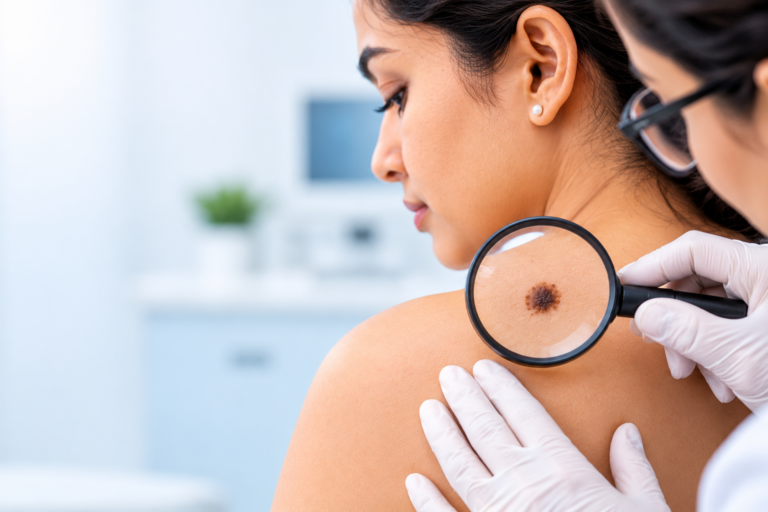
Dark spots are one of the most common reasons people with darker skin tones see a dermatologist. They form when inflammation tells the skin to make extra pigment.
The American Academy of Dermatology says a mark a few shades darker than your skin usually fades in 6 to 12 months once breakouts stop. Marks that sit deeper, often slate blue or gray, can take years. Treatment speeds this up.
What helps dark marks fade:
- Stop new breakouts. Every new pimple can leave a new mark.
- Wear sunscreen daily. A tinted SPF 30+ with iron oxide also blocks visible light, which can darken marks.
- Use a fading ingredient. Azelaic acid, glycolic acid, kojic acid, a retinoid or vitamin C can all help.
- Add a series of peels. Peels speed up the shedding of pigmented skin cells.
At Trillium, peels for marks and scars include salicylic acid, glycolic and TCA peels, brightening glutathione and kojic acid peels, and VI Peel. Every peel starts mild and steps up only as your skin allows.
Chemical peels for textured acne scars
Peels help shallow scars by prompting the skin to make more collagen and elastin. As collagen builds, mild dents look less noticeable. That’s the AAD’s explanation in its acne scar treatment guide.
The limit is depth. Mild and moderate peels, the only strengths Trillium offers, reach the upper layers of skin. They soften texture over time but won’t lift a deep scar. Our chemical peels page says this directly: for more extensive acne scars, we may recommend laser resurfacing.
For narrow ice pick scars, some dermatologists use TCA CROSS, where strong acid is dabbed into each scar. In a small 2010 study, 8 of 10 patients improved by more than 70% after four sessions.
How many chemical peels does it take?
Plan on a series. At Trillium, 4 to 8 peels spaced 10 to 14 days apart is typical. The AAD notes that a mild peel for scars often needs 3 to 5 treatments, 2 to 4 weeks apart.
You may be asked to prepare your skin for 2 to 4 weeks first, often with a retinoid and strict sun protection. This can improve results and lower the risk of new dark marks.
Peels, microneedling or laser: which is right for you?
- Mostly dark marks, little texture: a series of peels plus daily sunscreen and a fading cream.
- Marks plus shallow texture: peels combined with microneedling. The AAD notes microneedling is often paired with peels.
- Deep or widespread scars: laser resurfacing. Our laser scar removal guide explains the options.
Many people get the best result from more than one treatment over several months.
If you have darker skin
Darker skin is more likely to form new dark marks after irritation, including from a peel that’s too strong. Mild peels, a slow step-up and daily sunscreen keep that risk low. Read our guide to chemical peels for skin of color before you book.
Acne scar and dark mark treatment in Chapel Hill, Smithfield and Burlington
We’ll look at your marks and scars up close, tell you which ones a peel can help, and suggest another option where it can’t. Book a consultation to get a plan for your skin.
Frequently asked questions
They work well for flat dark marks and help shallow, uneven texture over a series. They don't remove deep scars, which usually need microneedling or laser resurfacing.
It depends on the scar. Mild to moderate peels such as glycolic or VI Peel suit dark marks and shallow texture. Deep, narrow ice pick scars may need TCA CROSS or laser.
Most people need a series. At Trillium, 4 to 8 peels spaced 10 to 14 days apart is typical.
A mark a few shades darker than your skin often fades in 6 to 12 months once breakouts stop. Deeper marks can take years. Sunscreen, fading creams and peels speed this up.
It can if the peel is too strong or your skin isn't protected from the sun afterward. Starting mild, stepping up slowly and wearing sunscreen daily lowers that risk.
Peels are better for dark marks. Microneedling is better for textured scars. Many people get the best result from both.
About Dr. Weiss
Stefan C. Weiss, MD, FAAD, is a board-certified dermatologist, the medical director of Trillium Clinic and an adjunct professor of dermatology at Brown University. He trained at Duke University School of Medicine and Stanford University Medical Center, has authored more than 100 peer-reviewed abstracts, posters and manuscripts, and has over two decades of experience in medical and cosmetic dermatology.
References
- American Academy of Dermatology. Acne scars: Consultation and treatment.
- American Academy of Dermatology. How to fade dark spots in darker skin tones.
- Bhardwaj D, Khunger N. An assessment of the efficacy and safety of CROSS technique with 100% TCA in the management of ice pick acne scars. J Cutan Aesthet Surg. 2010;3(2):93-96.
- American Academy of Dermatology. Chemical peels: FAQs.
This article is for general education and isn’t a substitute for personal medical advice. A board-certified dermatologist can tell you whether a chemical peel is right for you.