
What Patients Need to Know Before Saying Yes
Compounded medications are everywhere in dermatology right now marketed as personalized, premium, and more powerful than what you can get at a regular pharmacy. Patients are being prescribed them at med spas, wellness clinics, and online platforms at a rapidly growing rate.
But there is a critical conversation that is not happening loudly enough: compounded medications carry real risks, and the promises attached to them often outpace the evidence behind them.
At Trillium Dermatology in Chapel Hill, NC, we believe you deserve the full picture before any treatment touches your skin.
What Compounded Medications Actually Are
Compounded medications are custom-mixed preparations made by a compounding pharmacy rather than a licensed pharmaceutical manufacturer. They are not FDA-approved. That distinction matters more than most patients realize.
FDA approval means a medication has gone through rigorous clinical trials for safety, efficacy, potency, and stability. It means the manufacturing process is inspected and regulated. It means that what is on the label is what is in the bottle consistently, every time.
Compounded medications have none of those guarantees.
The Risks Patients Are Not Being Told About
No FDA oversight of the final product
Compounding pharmacies operate under a different and significantly lighter regulatory framework than pharmaceutical manufacturers. The FDA does not approve compounded formulations. Quality, potency, and sterility are not verified by an independent federal standard before the product reaches you.
Inconsistent potency
Studies have documented significant variability in the actual concentration of active ingredients in compounded products sometimes far below the labeled dose, sometimes dangerously above it. When you fill an FDA-approved prescription, you get a consistent, verified dose. With a compounded product, that consistency is not guaranteed.
Stability and contamination concerns
Commercial medications undergo extensive stability testing to ensure they remain safe and effective through their shelf life. Compounded formulations often lack this data. Contamination events at compounding pharmacies some resulting in serious patient harm have been documented and reported by the FDA.
Lack of clinical evidence
Many compounded formulations are sold with the implication that they are cutting-edge or superior to commercially available options. In most cases, that claim has not been tested in clinical trials. You are receiving a product whose real-world efficacy has never been independently validated.
Misleading marketing
The language around compounding “customized,” “personalized,” “pharmacy-crafted” is designed to sound rigorous. In practice, it frequently means less oversight, not more.
When Compounding Does Have a Legitimate Role
To be clear: compounding is not categorically wrong. There are narrow, legitimate clinical situations where it serves patients well for example, when a patient has a documented allergy to an inactive ingredient in an FDA-approved product, when a specific dosage form does not exist commercially, or when a medication has been discontinued and there is no alternative.
In those cases, working with a reputable, state-licensed 503B outsourcing facility held to stricter standards than a standard compounding pharmacy is essential.
But the widespread, routine prescribing of compounded topicals as a first-line or premium alternative to FDA-approved treatments? That is a different matter and one that warrants real scrutiny.
What We Recommend at Trillium Dermatology
Our approach at Trillium is grounded in evidence. Before we recommend any treatment compounded or otherwise we ask the same questions: Has this been studied? Is the manufacturing reliable? Is the risk-benefit profile appropriate for this patient?
In most cases, FDA-approved medications meet that standard better than compounded alternatives. When they do not, we will tell you and explain why, clearly.
Listen: Why Compounding in Dermatology Is More Complicated Than You've Been Told
This topic deserves a longer conversation. In our podcast episode on compounded medications, we break down exactly why the compounding market has grown so rapidly, what the regulatory gaps mean for patients, and how to ask the right questions if a compounded prescription is ever recommended to you.
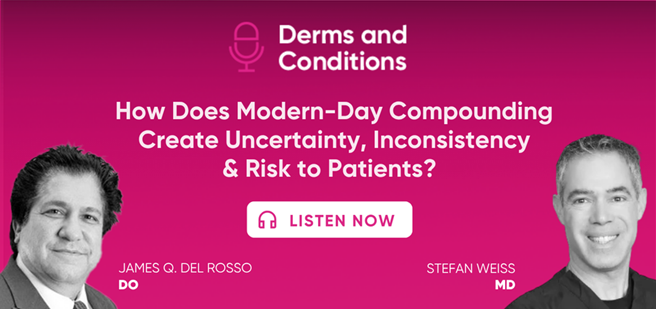
It is one of the most important conversations happening in dermatology right now and one most patients have never had.
Talk to a Board-Certified Dermatologist First
If you have been prescribed a compounded topical or if you are considering one we encourage you to schedule a consultation at Trillium Dermatology before proceeding. We serve patients throughout Chapel Hill, Durham, Carrboro, and the greater Triangle area of North Carolina.
